
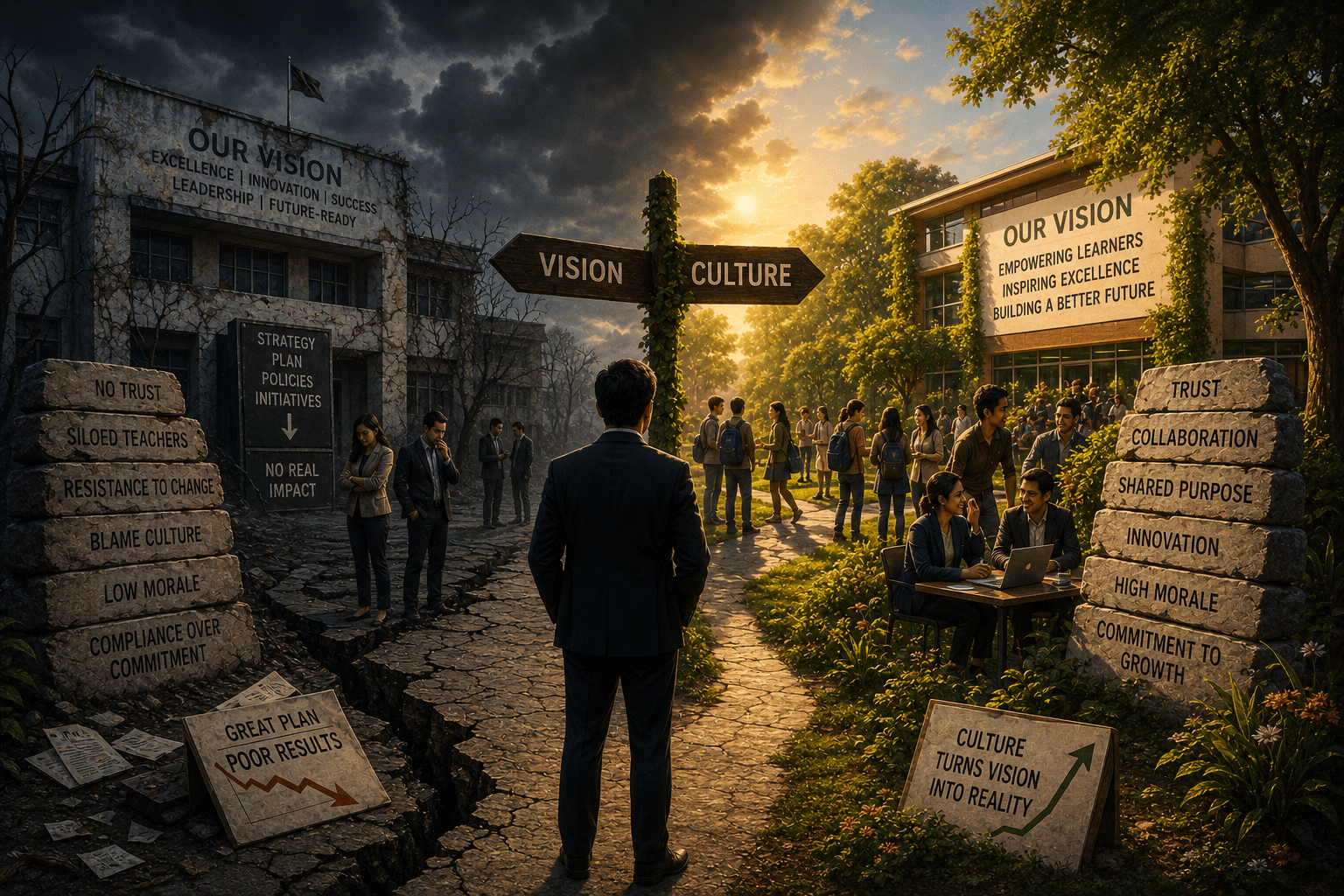
Why Vision Fails Without Culture
Turning Strategic Plans into Everyday Practice
Introduction
Almost every school has a vision.
It appears on websites, strategic plans, entrance walls, accreditation documents, and promotional brochures. It speaks of excellence, innovation, inclusion, lifelong learning, global citizenship, or preparing students for the future. These aspirations are thoughtfully written and often genuinely believed. Yet a fundamental question remains:
How often does a school’s vision influence the everyday decisions made inside its classrooms?
The challenge facing educational leadership today is not the absence of vision. Schools have never been better at articulating ambitious aspirations. The real challenge lies in translating those aspirations into consistent organisational behaviour.
A vision statement, regardless of how inspiring it may be, possesses little transformative power on its own. It cannot improve teaching, strengthen collaboration, cultivate innovation, or influence student learning unless it becomes embedded within the daily habits, professional relationships, leadership decisions, and organisational systems that shape school life. Vision inspires direction. Culture determines execution.
This distinction has become increasingly significant in an era of continuous disruption. Schools are expected to implement artificial intelligence responsibly, strengthen student wellbeing, redesign assessment, foster inclusion, develop future-ready competencies, and respond to rapidly changing societal expectations. Strategic priorities continue to expand, yet many initiatives fail to produce sustainable impact because they remain confined to documents rather than becoming embedded within organisational practice.
Perhaps the most important question educational leaders should ask is no longer, “Do we have a compelling vision?” A more revealing question is, “Can our teachers recognise that vision in the way our school operates every single day?”
The future of educational leadership will belong not to those who write the most ambitious strategic plans, but to those who create schools where vision becomes visible through behaviour.
The Strategy–Systems–Culture Gap
One of the greatest misconceptions in educational leadership is the assumption that a compelling vision naturally leads to meaningful transformation. In reality, the journey from aspiration to implementation is neither automatic nor linear. Between what a school intends to achieve and what it consistently accomplishes lies a critical organisational space that many leaders underestimate—the Strategy–Systems–Culture Gap.
Every strategic vision begins with intention. Schools define ambitious priorities such as developing future-ready learners, fostering innovation, embedding artificial intelligence responsibly, strengthening wellbeing, or promoting inquiry-based learning. These aspirations establish direction, but intention alone does not alter professional practice.
The second layer consists of organisational systems. Policies, recruitment processes, performance reviews, professional learning programmes, meeting structures, resource allocation, assessment frameworks, and timetables determine how the organisation operates. These systems translate strategic priorities into daily routines. Yet even well-designed systems remain insufficient if they are experienced merely as organisational requirements rather than shared professional commitments.
The deepest and most influential layer is culture. Culture determines what people instinctively do when no policy is being monitored, no leader is observing, and no checklist is being completed. It is reflected in the decisions teachers make inside classrooms, the conversations colleagues have after meetings, the way leaders respond to unexpected challenges, and the behaviours that become accepted as “the way we do things here.” At this level, organisational values cease to be written statements and become habitual practices.
This distinction explains why many educational reforms struggle to achieve lasting impact. Leaders frequently invest significant effort in refining strategic plans and introducing new systems while giving comparatively less attention to the cultural conditions required for those systems to thrive. The result is implementation without transformation. Policies are adopted, initiatives are launched, and professional development is delivered, yet everyday behaviours remain largely unchanged because the underlying culture has not evolved.
Future-ready schools recognise that sustainable improvement occurs only when these three layers operate in alignment. Strategy defines the destination. Systems establish the pathways. Culture ensures that the journey becomes embedded within the professional identity of the organisation. When alignment exists, improvement becomes self-sustaining rather than leader-dependent. When alignment is absent, even the most ambitious vision risks becoming another document admired in principle but rarely experienced in practice.
For educational leaders, the challenge is therefore not simply to communicate a compelling vision, but to ensure that every organisational system and every cultural norm consistently reinforces that vision. Transformation begins when strategic aspirations become everyday habits.
From Vision to Behaviour: Why Organisational Coherence Matters
One of the most significant developments in educational leadership research over the past decade has been a growing recognition that successful school improvement depends less on the quality of strategic plans than on the coherence of the organisation implementing them. Schools rarely fail because they lack ambitious ideas. More often, improvement stalls because vision, systems, leadership behaviours, and classroom practice evolve independently rather than as parts of a coherent whole.
Anthony Bryk’s work at the University of Chicago, later extended through the Carnegie Foundation for the Advancement of Teaching, demonstrated that sustainable school improvement is fundamentally an organisational challenge rather than simply an instructional one. His research showed that schools improve when essential elements—including leadership, professional capacity, relational trust, instructional guidance, and continuous improvement processes—operate as an integrated system rather than isolated initiatives. Fragmented reforms rarely generate lasting impact because organisational coherence is absent.
This insight has become even more relevant as schools navigate the complexities of artificial intelligence, digital transformation, competency-based education, and rapidly changing societal expectations. Educational leaders frequently introduce multiple initiatives simultaneously—AI integration, assessment reform, wellbeing programmes, inclusion strategies, sustainability projects, and professional learning communities. Individually, each initiative may be well designed. Collectively, however, they often compete for attention because they are insufficiently connected to a shared organisational purpose.
Michael Fullan describes this challenge as one of coherence-making rather than simply change management. Effective leaders do not ask staff to implement a growing collection of disconnected priorities. Instead, they help people understand how every initiative contributes to a common educational purpose. Organisational coherence reduces complexity by enabling teachers to see meaningful connections rather than isolated demands.
Recent implementation research reinforces this perspective. Studies in implementation science increasingly conclude that evidence alone does not transform organisations. Successful implementation depends on leadership capacity, aligned systems, stakeholder engagement, and organisational readiness to translate ideas into everyday practice. In other words, improvement is not achieved when schools discover better strategies; it is achieved when they become better at implementing those strategies consistently.
This distinction may define the next generation of educational leadership. Future-ready schools will not necessarily be those with the most ambitious strategic plans or the longest list of initiatives. They will be those that achieve behavioural alignment—where strategic vision, organisational systems, leadership decisions, professional learning, and classroom practice consistently reinforce one another. In such schools, vision is no longer communicated through mission statements alone; it becomes visible in the everyday choices people make throughout the organisation.
Ultimately, the question facing educational leaders is no longer, “Do we have a compelling vision?” The more consequential question is, “Is every system within our school helping people live that vision every day?” The answer to that question determines whether strategy remains an aspiration or becomes organisational reality.
What Future-Ready Leaders Align
Future-ready leadership is not measured by how eloquently a vision is articulated, but by how intelligently that vision is engineered into the daily life of the school. The most effective leaders understand that aspiration must travel through systems before it reaches classrooms. If the vision is to become more than language, it must shape the structures, routines, conversations, and decisions through which the school actually operates.
The first area leaders must align is professional learning. If a school claims to value innovation, inquiry, artificial intelligence literacy, or student-centred learning, then teacher development cannot remain limited to occasional workshops or compliance-based training. Professional learning must become sustained, collaborative, evidence-informed, and closely connected to classroom practice. Teachers need time to experiment, reflect, receive feedback, and refine their pedagogy. Without this alignment, vision remains aspirational while instructional practice remains unchanged.
The second area is assessment. Schools often speak of creativity, critical thinking, collaboration, and future-ready competencies while continuing to assess students almost exclusively through memory, speed, and reproduction of content. This creates a profound contradiction. Students quickly learn what the system truly values through what it measures. If assessment practices do not reflect the school’s stated vision, learners receive mixed messages about what matters.
The third area is leadership behaviour. No strategic plan can compensate for inconsistency between what leaders say and what leaders model. If leaders promote collaboration but make decisions in isolation, advocate reflection but reward only immediate results, or celebrate innovation while punishing intelligent risk-taking, the culture will believe the behaviour rather than the statement. Vision gains credibility only when leadership conduct becomes its most visible evidence.
The fourth area is resource allocation. Budgets, timetables, staffing decisions, digital tools, learning spaces, and meeting agendas reveal institutional priorities more honestly than promotional language. A school that values wellbeing must protect time for relationships and support systems. A school that values deep learning must protect time for planning, inquiry, reading, dialogue, and feedback. A school that values teacher professionalism must invest in coaching, collaboration, and meaningful growth rather than superficial monitoring.
Finally, leaders must align recognition. What a school celebrates becomes what people pursue. If public praise is reserved only for examination performance, compliance, or competition, then those priorities will dominate organisational attention. If leaders also recognise curiosity, ethical leadership, collaborative practice, inclusive teaching, reflective improvement, and student voice, they gradually expand the cultural definition of success.
This is where vision becomes operational. Future-ready leaders do not merely ask whether their school has the right aspirations. They ask whether every system is sending the same message. When professional learning, assessment, leadership behaviour, resource allocation, and recognition all reinforce the same educational purpose, vision stops being a statement and becomes the lived architecture of the school.
From Insight to Action
A compelling vision should be evident not only in strategic documents but also in the everyday decisions that shape organisational life. Future-ready leaders therefore move beyond asking whether staff understand the vision. They regularly evaluate whether the systems of the school are reinforcing—or quietly undermining—it.
1. Conduct a Vision Alignment Audit
Review your school’s key organisational systems and ask a simple question of each:
Does this system strengthen our vision or simply sustain existing routines?
Examine your:
- recruitment and induction processes,
- professional learning programme,
- assessment practices,
- meeting structures,
- performance reviews,
- budget priorities,
- technology investments, and
- communication with families.
If these systems communicate different priorities from your strategic vision, the organisation will inevitably follow the systems rather than the vision.
2. Eliminate Initiative Overload
One of the defining challenges facing schools today is not a shortage of good ideas but an excess of competing priorities. Curriculum reform, AI integration, wellbeing, sustainability, digital citizenship, inclusion, safeguarding, competency-based learning, and assessment redesign all demand attention.
Future-ready leaders resist the temptation to treat every priority as a separate initiative. Instead, they identify a small number of strategic priorities and deliberately connect every new project back to them. Coherence creates momentum; fragmentation creates fatigue.
3. Make Vision Visible in Leadership Decisions
Staff members interpret organisational priorities less from strategic plans than from leadership behaviour.
Ask yourself:
- What behaviours are recognised publicly?
- Which projects receive the greatest investment?
- What dominates leadership meetings?
- What do classroom observations emphasise?
- Which conversations receive the most attention?
The answers reveal the school’s operational vision, regardless of what is written in official documents.
4. Measure Cultural Indicators, Not Only Performance Indicators
Educational organisations have become increasingly sophisticated at measuring attainment, attendance, examination performance, and operational efficiency. These metrics remain important, but they tell only part of the story.
Future-ready schools also monitor indicators such as:
- teacher collaboration,
- psychological safety,
- staff wellbeing,
- innovation,
- student agency,
- professional learning,
- and organisational trust.
These are often the leading indicators of sustainable improvement, while academic outcomes are the lagging indicators that appear later.
5. Build Coherence Before Scaling Innovation
Before launching a new initiative, ask whether the organisation has the cultural capacity to sustain it.
A school does not become innovative because it adopts artificial intelligence, redesigns classrooms, or introduces new technologies. Innovation becomes sustainable only when leadership, systems, professional learning, and organisational culture evolve together.
Leadership Challenge for This Week
Gather your leadership team and complete this sentence individually before discussing your answers:
“If an external visitor spent one week in our school, what would they conclude is our real organisational priority?”
Now compare those responses with your published vision statement.
If the two descriptions are significantly different, your next leadership priority is not writing a better vision—it is creating stronger organisational alignment.
Cafe Learning Reflection
Educational leaders are often remembered for the initiatives they introduced, the strategic plans they developed, or the reforms they championed. Yet history suggests that the most enduring leaders are remembered for something far less tangible—they built organisations whose values continued to shape decisions long after they had moved on.
A vision has little significance if it exists only in policy documents or strategic presentations. Its true value is revealed when it becomes embedded in the everyday habits of the organisation: in how teachers collaborate, how students are supported, how decisions are made, and how people respond when no one is monitoring their actions. At that point, vision is no longer an aspiration; it becomes part of the institution’s identity.
As schools prepare learners for an increasingly complex and unpredictable future, educational leadership must also evolve. The challenge is no longer simply to define where a school wants to go, but to design organisations capable of translating shared purpose into consistent action. This requires leaders to think less about launching new initiatives and more about creating coherence across people, systems, culture, and practice.
Perhaps the ultimate measure of leadership is not whether people can recite the school’s vision statement, but whether they instinctively live its values. When vision becomes behaviour, culture becomes the custodian of leadership, ensuring that improvement continues not because leaders demand it, but because the organisation has learned to sustain it.
Selected References
Argyris, C., & Schön, D. A. (1996). Organizational Learning II: Theory, Method, and Practice. Addison-Wesley.
Bryk, A. S., Gomez, L. M., Grunow, A., & LeMahieu, P. G. (2015). Learning to Improve: How America’s Schools Can Get Better at Getting Better. Harvard Education Press.
Bryk, A. S., & Schneider, B. (2002). Trust in Schools: A Core Resource for Improvement. Russell Sage Foundation.
Fullan, M., & Quinn, J. (2016). Coherence: The Right Drivers in Action for Schools, Districts, and Systems. Corwin.
Kotter, J. P. (2012). Leading Change. Harvard Business Review Press.
Robinson, V. M. J. (2011). Student-Centered Leadership. Jossey-Bass.
Schein, E. H., & Schein, P. A. (2021). Organizational Culture and Leadership (6th ed.). Wiley.
Spillane, J. P. (2006). Distributed Leadership. Jossey-Bass.
UNESCO. (2021). Reimagining Our Futures Together: A New Social Contract for Education. UNESCO Publishing.
World Economic Forum. (2025). The Future of Jobs Report 2025. World Economic Forum.