
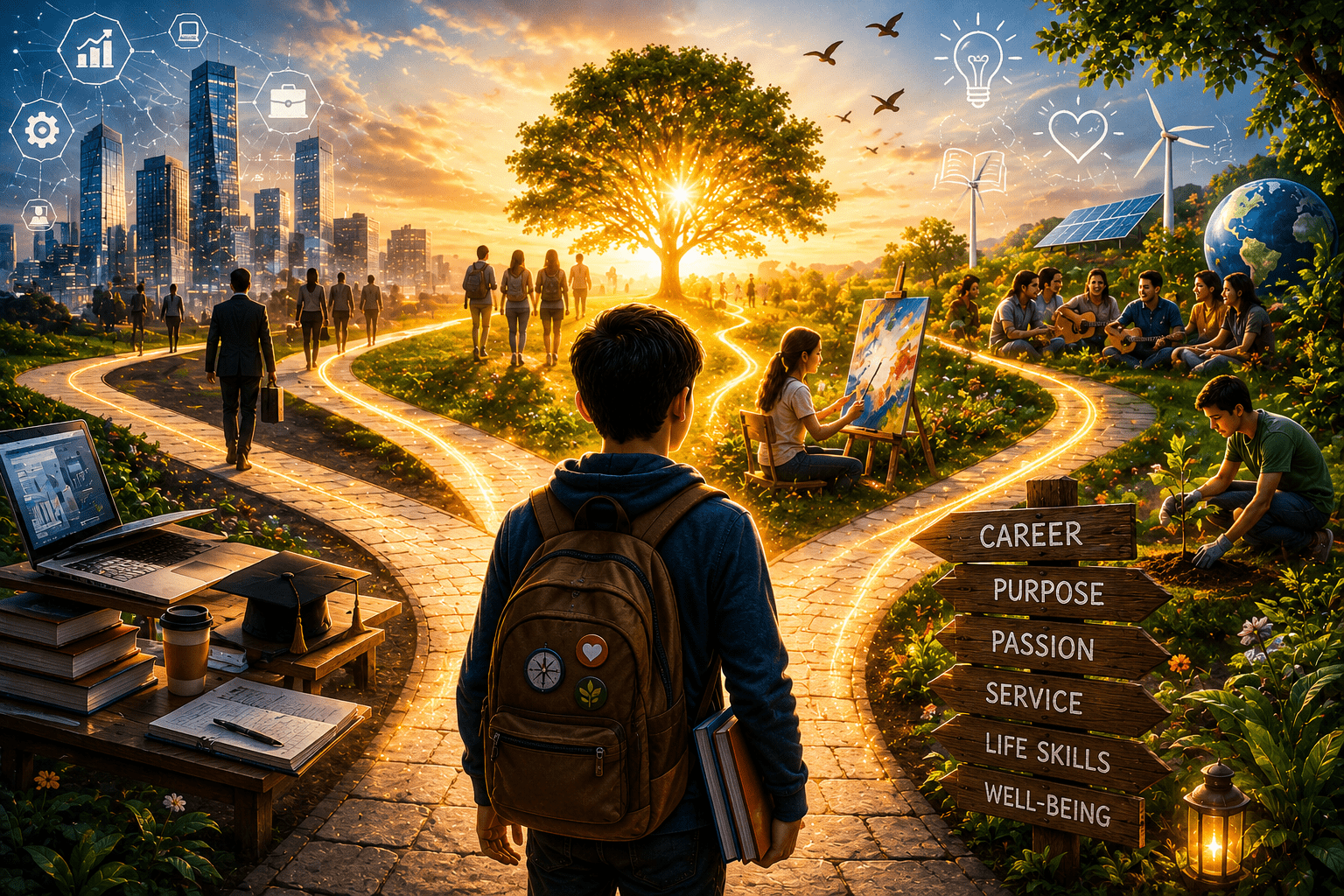
Education Beyond Employability
Why Schools Must Prepare Students for Life, Not Just Work
Introduction
Never before have schools faced greater pressure to prepare students for employment. Governments emphasise workforce readiness, employers call for future skills, universities promote career pathways, and educational success is increasingly measured by graduate employability. These priorities are understandable. Meaningful work provides financial security, personal fulfilment, and opportunities to contribute to society. Preparing young people for employment is therefore an important responsibility of education.
Yet an important question often remains unasked. Should employability be the ultimate purpose of education, or simply one of its outcomes?
The distinction matters because education has always served purposes that extend beyond economic productivity. Schools prepare future professionals, but they also prepare citizens, parents, community members, innovators, and leaders. They help learners develop intellectual curiosity, ethical judgement, cultural understanding, resilience, empathy, and the capacity to navigate an increasingly complex world. These qualities cannot be reduced to employment statistics, yet they are essential for both individual flourishing and the wellbeing of society.
The emergence of artificial intelligence makes this conversation even more urgent. As technologies rapidly reshape labour markets and automate many routine tasks, technical skills alone are unlikely to remain sufficient throughout a lifetime. The most enduring educational advantage may no longer be preparing students for a particular job, but preparing them to adapt, continue learning, exercise sound judgement, and contribute meaningfully in a world of continual change.
Perhaps the future of education should not be measured solely by the number of students who secure employment after graduation. It should also be measured by the kind of people they become, the communities they strengthen, and the positive difference they make throughout their lives.
Employability Is an Outcome, Not the Purpose of Education
Preparing students for meaningful employment is one of education’s most important responsibilities. Stable employment contributes to financial independence, personal dignity, social mobility, and economic development. Schools and universities therefore have a legitimate obligation to equip learners with the knowledge, skills, and professional competencies required to participate successfully in an evolving labour market. The challenge is not that education values employability—it is that employability is too often mistaken for education’s ultimate purpose.
This distinction has become increasingly significant as governments, policymakers, and employers place growing emphasis on workforce readiness. Educational success is frequently evaluated through graduate employment rates, labour market outcomes, and economic productivity. While these indicators provide valuable evidence of institutional effectiveness, they represent only one dimension of what education seeks to accomplish. A society benefits not only from employable graduates but also from thoughtful citizens, ethical professionals, engaged community members, and lifelong learners capable of adapting to continual change.
Artificial intelligence further challenges a narrow employability agenda. The future of work is unlikely to depend solely on mastering technical knowledge or job-specific skills, many of which will evolve or become obsolete within relatively short periods. Instead, employers increasingly value qualities that remain difficult to automate: critical thinking, creativity, collaboration, ethical judgement, emotional intelligence, adaptability, and effective communication. These capabilities enable individuals not merely to perform existing jobs but to navigate careers that will continue to evolve throughout their lives.
Perhaps the most enduring contribution of education is therefore not preparing students for a single profession but preparing them for a lifetime of learning. Careers will change, industries will transform, and technologies will continue to redefine the nature of work. Individuals who possess intellectual curiosity, resilience, sound judgement, and the confidence to acquire new knowledge will be better equipped to thrive amid uncertainty than those whose education focused exclusively on immediate employment needs.
This broader perspective also recognises that human identity extends beyond occupation. A person’s contribution to society cannot be measured solely by professional success or economic productivity. Education prepares individuals to participate in democratic life, build healthy relationships, appreciate cultural diversity, care for their communities, and make responsible decisions that influence future generations. Employment is undoubtedly important, but it represents only one aspect of a meaningful and purposeful life.
When employability becomes the destination, education risks narrowing its vision. When employability is understood as one important outcome within a much broader educational mission, schools can prepare graduates who are not only capable professionals but also reflective thinkers, ethical leaders, compassionate citizens, and lifelong learners. That distinction may prove essential in a world where careers are increasingly unpredictable, but the need for wisdom, integrity, and human judgement remains constant.
Educating for Human Flourishing
If education extends beyond employability, then schools must embrace a broader understanding of human success. Employment provides individuals with income, stability, and opportunities for professional contribution, but a meaningful life requires far more than occupational achievement. Education should therefore aspire not only to prepare students for the labour market but also to prepare them to lead thoughtful, responsible, and fulfilling lives.
This broader vision places human flourishing at the centre of education. Flourishing is not defined solely by academic excellence, career advancement, or economic productivity. It encompasses intellectual curiosity, emotional wellbeing, ethical responsibility, meaningful relationships, civic participation, cultural understanding, and the capacity to continue growing throughout life. These qualities enable individuals to contribute positively to society while leading lives characterised by purpose and integrity.
Such an educational vision is particularly important in an era of rapid technological change. As artificial intelligence transforms industries and automates routine tasks, the most enduring human capabilities are likely to be those that technology cannot easily replicate. Empathy, moral judgement, creativity, wisdom, resilience, collaboration, and reflective thinking will continue to distinguish individuals who can lead, innovate, and strengthen their communities. Schools therefore have an opportunity to cultivate capacities that remain valuable regardless of how the future of work evolves.
This perspective also reshapes the way educational success is understood. Instead of asking only whether graduates secure employment, we might also ask whether they become informed citizens, compassionate leaders, ethical professionals, lifelong learners, and active contributors to their communities. These outcomes are more difficult to quantify than examination scores or employment statistics, yet they represent many of the qualities societies ultimately depend upon for long-term prosperity and social cohesion.
Preparing students for work and preparing them for life are not competing educational goals. They are complementary. Employment enables individuals to participate economically, while education enables them to participate meaningfully in society. The most successful schools recognise that professional competence and human development are not separate ambitions but interconnected dimensions of a truly future-ready education.
When education embraces this broader purpose, employability becomes one important milestone rather than the final destination. Schools begin to prepare graduates who are capable of succeeding in their careers while also possessing the wisdom, character, and adaptability to lead lives of significance beyond the workplace.
Cafe Learning Reflection
The value of education has never been determined solely by the careers it creates, but by the lives it shapes. Employment undoubtedly matters. It provides opportunity, independence, and the means to contribute productively to society. Yet education fulfils a far greater purpose when it helps individuals discover not only how to earn a living, but also how to live with integrity, purpose, and responsibility.
As artificial intelligence continues to transform the future of work, schools will inevitably face increasing pressure to produce graduates with marketable skills and professional competencies. These expectations are both reasonable and necessary. However, if education limits its ambitions to employability alone, it risks overlooking the qualities that make meaningful employment—and meaningful lives—possible: curiosity, ethical judgement, resilience, compassion, adaptability, and a lifelong commitment to learning.
The most successful education systems will not be those that simply respond to labour market demands. They will be those that recognise work as one important dimension of human life rather than its defining purpose. Schools should certainly prepare students for professions, but they should also prepare them for citizenship, relationships, leadership, service, and thoughtful participation in an increasingly interconnected world.
Ultimately, education achieves its highest purpose when students leave not only ready to build successful careers, but also equipped to build meaningful lives. Preparing learners for work may secure their future employment. Preparing them for life may help secure the future of society.
Selected References
Biesta, G. (2020). Educational Research: An Unorthodox Introduction. Bloomsbury Academic.
Dewey, J. (1916). Democracy and Education. Macmillan.
Freire, P. (1970). Pedagogy of the Oppressed. Continuum.
Nussbaum, M. C. (2010). Not for Profit: Why Democracy Needs the Humanities. Princeton University Press.
OECD. (2019). OECD Learning Compass 2030: A Series of Concept Notes. OECD Publishing.
Schleicher, A. (2018). World Class: How to Build a 21st-Century School System. OECD Publishing.
UNESCO. (2021). Reimagining Our Futures Together: A New Social Contract for Education. UNESCO Publishing.
UNESCO. (2023). Guidance for Generative AI in Education and Research. UNESCO Publishing.
World Economic Forum. (2023). The Future of Jobs Report 2023. World Economic Forum.
Zhao, Y. (2012). World Class Learners: Educating Creative and Entrepreneurial Students. Corwin.