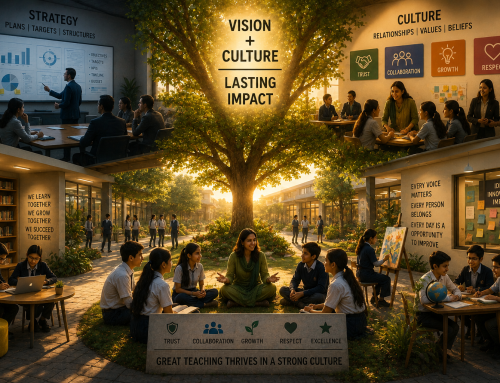

The Hidden Curriculum: The Lessons Schools Teach Without Realizing It
Why School Culture Often Educates More Powerfully Than the Curriculum Itself
“The most influential lessons students learn are often the ones that were never written into the curriculum.”
Introduction
As I have visited schools over the years, one observation has remained remarkably consistent regardless of the school’s size, curriculum, or examination board. I have walked into classrooms displaying beautifully designed learning objectives, meticulously prepared lesson plans, and carefully aligned assessment tasks. Yet within moments, it often becomes evident that another curriculum is unfolding alongside the official one—one that is rarely documented, seldom discussed, and almost never evaluated.
It reveals itself in subtle but consequential ways. It appears in whose questions receive the teacher’s attention and whose are quietly overlooked. It is reflected in the arrangement of classroom furniture, the expectations attached to student behaviour, the language used to praise success or correct mistakes, and even the assumptions adults make about leadership, intelligence, discipline, and potential. Long before students consciously analyse these experiences, they begin internalising powerful messages about who they are, where they belong, and what is valued within the learning community.
Educational leaders frequently devote considerable energy to curriculum reform, assessment frameworks, instructional improvement, and digital innovation. These initiatives are undeniably important. However, many reforms fail to achieve their intended impact because they overlook an equally powerful force operating beneath the surface: the hidden curriculum.
The hidden curriculum encompasses the implicit values, beliefs, social norms, and cultural expectations that students absorb through the everyday life of a school rather than through formally prescribed learning objectives. Unlike the written curriculum, which is explicitly planned and assessed, the hidden curriculum is transmitted through routines, relationships, institutional structures, language, traditions, disciplinary practices, and organisational culture. It teaches students what a community truly values—not through policy documents, but through lived experience.
This distinction has become increasingly significant in the twenty-first century. Schools are now expected not only to develop academic proficiency but also to cultivate global competence, ethical citizenship, critical thinking, intercultural understanding, adaptability, and social responsibility. These aspirations cannot be realised solely through curriculum documents or mission statements. Students evaluate the authenticity of these commitments by observing whether the daily practices of their school reinforce or contradict them.
A school may proudly declare that it values student voice, yet rarely invite learners into meaningful decision-making. It may advocate creativity while rewarding only conformity. It may celebrate diversity during designated cultural events while presenting a curriculum that privileges only a narrow range of historical narratives and intellectual traditions. Such contradictions become powerful educational experiences in themselves. In many respects, students learn far more from the culture they inhabit than from the objectives displayed on classroom walls.
This understanding invites educational leaders to reconsider a fundamental assumption. Curriculum is not merely a collection of subjects, textbooks, and assessment standards. It is also an ecosystem of relationships, expectations, identities, and experiences that continuously shape how learners perceive themselves and the world around them. Every interaction communicates values. Every organisational routine conveys priorities. Every leadership decision contributes to an educational narrative that extends well beyond formal instruction.
The educational philosopher John Dewey argued that education is not preparation for life but life itself. His insight is particularly relevant when examining the hidden curriculum. Students do not postpone learning about authority, equity, belonging, or justice until adulthood; they encounter these concepts every day through the ordinary experiences of school. Whether intentionally or unintentionally, schools become living demonstrations of the democratic, ethical, and cultural principles they claim to uphold.
Recognising the hidden curriculum, therefore, is not an invitation to criticise schools but an opportunity to understand them more deeply. Before leaders redesign programmes, introduce new technologies, or revise strategic plans, they must first ask a more searching question:
What are our students learning here that we never intended to teach?
That question may ultimately reveal more about the quality of a school’s education than any examination result or accountability framework ever could.
Understanding the Hidden Curriculum: The Education That Happens Between the Lessons
When educational discourse focuses on curriculum, the conversation typically revolves around standards, learning outcomes, textbooks, instructional resources, and assessment frameworks. These elements constitute what curriculum theorists describe as the formal curriculum—the explicitly planned knowledge, skills, and competencies that schools intend students to acquire. Yet, alongside this carefully designed architecture of learning exists another educational force that is equally influential, though far less visible. This is the hidden curriculum.
The concept of the hidden curriculum was first brought to prominence through the work of educational sociologists such as Philip W. Jackson, whose seminal book Life in Classrooms (1968) demonstrated that students learn far more than academic content during their years in school. They also learn how authority functions, how conformity is rewarded, how competition is valued, how success is defined, and what behaviours are considered socially acceptable. These lessons are rarely written into curriculum guides, yet they often leave a deeper and more enduring imprint on learners than formal instruction itself.
Subsequent scholars, including Michael Apple, Henry Giroux, and Pierre Bourdieu, expanded this understanding by arguing that schools are not merely institutions of knowledge transmission but also sites where cultural values, social hierarchies, and institutional norms are reproduced. Through everyday routines, language, expectations, and organisational structures, schools communicate implicit assumptions about power, identity, achievement, gender, culture, and belonging. Students absorb these messages not because teachers explicitly teach them, but because they experience them repeatedly as part of the ordinary life of schooling.
This perspective challenges one of the most enduring assumptions in education: that students learn only what teachers intentionally teach. In reality, every educational environment communicates two curricula simultaneously. The first is articulated through lesson objectives, instructional activities, and assessment criteria. The second is communicated through the school’s culture—through whom teachers praise, whose voices dominate classroom discussions, how mistakes are treated, which traditions are celebrated, how leadership is exercised, and whose knowledge is consistently positioned as legitimate.
For example, a school may formally advocate collaboration while structuring every significant learning experience around individual competition. It may proclaim that creativity is essential for the future while rewarding only those students who reproduce predetermined answers. Similarly, a curriculum may emphasize inclusion and diversity, yet the overwhelming majority of classroom displays, prescribed texts, historical narratives, and examples continue to privilege a narrow range of cultural perspectives. In each of these cases, students encounter two conflicting educational messages. Over time, they tend to believe the one demonstrated through daily practice rather than the one articulated in policy documents.
This distinction has become increasingly important as education systems seek to prepare learners for an era characterised by rapid technological advancement, artificial intelligence, global interdependence, and complex societal challenges. Frameworks developed by organisations such as the OECD, UNESCO, and the World Economic Forum consistently identify competencies such as collaboration, adaptability, intercultural understanding, ethical reasoning, creativity, and critical thinking as essential for the future. Yet these competencies cannot flourish within school cultures that implicitly reward compliance over curiosity, uniformity over diversity, or performance over genuine learning. The hidden curriculum ultimately determines whether these aspirations become lived realities or remain rhetorical ambitions.
Importantly, the hidden curriculum is not inherently negative. Every school possesses one because every organisation develops its own culture, traditions, and unwritten norms. A positive hidden curriculum can cultivate empathy, integrity, intellectual curiosity, resilience, democratic participation, and a genuine sense of belonging. Conversely, an unexamined hidden curriculum can unintentionally reinforce inequity, silence student voice, discourage innovation, perpetuate stereotypes, and normalize exclusion. The issue, therefore, is not whether schools have a hidden curriculum, but whether educational leaders are sufficiently aware of the messages it conveys.
Recognising the hidden curriculum requires leaders to shift their attention from what schools teach to what schools communicate. This distinction is subtle yet profound. Students are constantly interpreting not only the curriculum they study but also the culture they inhabit. They notice who receives opportunities, whose perspectives are valued, how conflict is resolved, whether mistakes are treated as opportunities for growth or as evidence of failure, and whether respect is demonstrated consistently across all members of the school community. These observations gradually shape learners’ beliefs about themselves, about others, and about the kind of society education expects them to build.
Ultimately, the hidden curriculum reminds us that education is not confined to classrooms, lesson plans, or examinations. It is embedded within the everyday experiences of schooling itself. Every routine, interaction, policy, and leadership decision becomes an act of teaching, whether intentionally designed or not. Understanding this reality is the first step toward creating schools where the values embedded in institutional culture genuinely reflect the educational ideals they aspire to achieve.
How School Routines Shape Identity, Power, and Belonging
The hidden curriculum rarely announces itself through dramatic policies or explicit instruction. Instead, it is embedded within the seemingly ordinary routines that structure everyday school life. Morning assemblies, classroom seating arrangements, participation patterns, disciplinary procedures, reward systems, parent interactions, staff meetings, and even the language displayed on classroom walls collectively communicate a powerful educational narrative. These practices often appear neutral because they have become institutional habits. Yet from a learner’s perspective, they continuously answer fundamental questions about identity, belonging, authority, and success.
Perhaps the most profound lesson communicated through the hidden curriculum concerns who belongs. Human beings possess an innate need to feel recognised, valued, and accepted within their communities, and schools are among the first public institutions where children begin constructing this sense of social identity. Students quickly develop perceptions about whether their voices matter, whether their cultural backgrounds are respected, whether mistakes are viewed as opportunities for growth or as evidence of inadequacy, and whether they are regarded as capable contributors to the learning community. These understandings emerge gradually through accumulated experiences rather than isolated events.
Educational psychologist Albert Bandura’s work on social learning reminds us that learners acquire behaviours, attitudes, and expectations not only through direct instruction but also through observation and modelling. Students constantly observe how adults interact with one another, whose opinions receive serious consideration, how disagreement is managed, and how authority is exercised. A school that encourages respectful dialogue among adults teaches democratic participation long before students encounter the concept in a civics lesson. Conversely, environments characterised by excessive hierarchy or inconsistent treatment may unintentionally teach that power outweighs fairness and that compliance is valued more highly than thoughtful engagement.
School routines also shape students’ understanding of intelligence. Although many educational systems publicly embrace the principles of growth mindset and differentiated learning, the hidden curriculum may communicate a very different message. Consider classrooms where the same students are consistently praised for being “naturally gifted,” while perseverance, creativity, collaboration, or improvement receive comparatively little recognition. Over time, learners begin to associate intelligence with speed, memorisation, or examination performance rather than with curiosity, resilience, or intellectual risk-taking. Such messages influence not only academic confidence but also students’ willingness to embrace challenge throughout their educational journey.
Similarly, the organisation of classroom participation often communicates subtle assumptions about whose ideas deserve attention. In many classrooms, participation appears voluntary, yet opportunities are distributed unevenly. Teachers, often unintentionally, may respond more readily to confident speakers, overlook quieter learners, or unconsciously hold different expectations for students based on previous achievement, gender, language proficiency, or behaviour. Educational research has consistently demonstrated that teacher expectations can significantly influence student performance through what is commonly known as the Pygmalion Effect. When certain learners repeatedly receive more encouragement, more challenging questions, or greater intellectual trust, the hidden curriculum quietly reinforces beliefs about competence and capability.
Questions of power are equally embedded within the daily life of schools. Every institution establishes norms regarding decision-making, autonomy, and responsibility. In some schools, students participate meaningfully in shaping aspects of school life through student councils, inquiry projects, collaborative rule-setting, or restorative conversations. In others, nearly every decision is made for students rather than with them. While both environments may deliver the same academic curriculum, they cultivate profoundly different understandings of citizenship, leadership, and agency. Learners educated within participatory cultures are more likely to perceive themselves as active contributors to society, whereas highly controlled environments may inadvertently encourage dependency and passive compliance.
The hidden curriculum also influences how students perceive diversity and difference. Inclusion is not communicated solely through admissions policies or mission statements; it is experienced through everyday interactions. Students notice whose holidays are acknowledged, whose languages are welcomed, whose histories are represented within the curriculum, and whose perspectives are routinely invited into classroom discussions. These seemingly modest decisions accumulate into broader messages about whose identities are visible, whose experiences are considered legitimate, and whose contributions are regarded as valuable within the educational community. As educational theorist Rudine Sims Bishop argued through her influential metaphor of mirrors, windows, and sliding glass doors, learning environments should enable students to recognise themselves while also developing an authentic understanding of others.
Increasingly, these questions extend beyond physical classrooms into digital learning environments. As schools integrate artificial intelligence, adaptive learning platforms, and educational technologies, a new digital hidden curriculum is beginning to emerge. Algorithms influence which resources students encounter, digital platforms shape patterns of participation, and automated feedback can subtly redefine how learners interpret success, error, and progress. Educational leaders therefore face an expanded responsibility: to examine not only the hidden curriculum embedded within school culture but also the implicit values communicated through the technologies that increasingly mediate teaching and learning.
Ultimately, the hidden curriculum reminds us that students are always learning, even when formal instruction has paused. Every interaction, organisational routine, and leadership decision contributes to an evolving understanding of what knowledge is valued, how people should relate to one another, and what kind of society the school is preparing young people to inhabit. If the formal curriculum answers the question, “What should students know?” the hidden curriculum answers a far more enduring one: “Who should students become?” It is in the relationship between these two curricula that the true character of an educational institution is revealed.
Five Hidden Curriculum Messages Every School Should Audit
One of the greatest challenges associated with the hidden curriculum is that it often remains invisible to those responsible for shaping it. School leaders rarely set out to communicate inequity, discourage curiosity, or limit student agency. On the contrary, most educational institutions are founded upon aspirations of excellence, inclusion, and holistic development. Yet the daily realities experienced by students do not always reflect these aspirations. The hidden curriculum emerges not through intentional design alone, but through accumulated organisational habits that gradually become accepted as “the way things are.”
For this reason, improving the hidden curriculum requires more than revising policy documents or introducing isolated initiatives. It requires leaders to adopt the mindset of cultural architects, critically examining whether the everyday experiences of students align with the values the institution publicly claims to uphold. Educational improvement begins when leaders become curious not only about academic outcomes but also about the invisible messages their schools communicate each day.
The following five dimensions provide a practical framework for auditing the hidden curriculum. They are not designed as compliance indicators but as reflective lenses through which educational leaders can examine the lived experiences of learners.
- What Does Your School Communicate About Success?
Every school defines success, whether intentionally or implicitly. The critical question is whether success is understood narrowly as examination performance or more broadly as intellectual growth, ethical character, creativity, collaboration, resilience, and lifelong learning.
Students carefully observe who receives recognition during assemblies, whose work is displayed on classroom walls, which achievements are celebrated in newsletters, and what qualities teachers consistently praise. If academic ranking becomes the dominant measure of accomplishment, learners may conclude that empathy, innovation, leadership, artistic talent, service, and perseverance are of secondary importance. Over time, this narrows students’ understanding of both achievement and personal worth.
A hidden curriculum that promotes holistic education celebrates diverse forms of excellence and communicates that every learner possesses strengths capable of contributing meaningfully to the school community.
- Whose Voices Are Consistently Heard—and Whose Are Missing?
Student voice has become a familiar phrase within contemporary educational discourse, yet genuine participation extends far beyond inviting students to answer classroom questions. Schools communicate powerful messages about belonging through the distribution of opportunities to speak, lead, question, challenge ideas, and influence decisions.
Leaders should ask whether classroom discussions consistently privilege the most confident learners, whether multilingual students feel equally able to contribute, whether quieter voices are intentionally cultivated, and whether student councils genuinely influence school life or function primarily as symbolic structures. Equally important is examining whose perspectives are represented within the curriculum itself. Do classroom resources reflect diverse cultures, identities, disciplines, and lived experiences, or do they reinforce a limited understanding of whose knowledge matters?
A culture that values multiple perspectives prepares learners not only for academic success but also for democratic participation within increasingly diverse societies.
- How Does Your School Respond to Mistakes?
The treatment of error reveals more about a school’s philosophy of learning than any mission statement ever could. In classrooms where mistakes are primarily associated with punishment, embarrassment, or failure, students quickly learn that intellectual safety is fragile. Consequently, many become reluctant to ask questions, experiment with unfamiliar ideas, or engage in productive academic risk-taking.
By contrast, schools grounded in inquiry-oriented learning recognise mistakes as indispensable components of intellectual growth. Teachers model reflective thinking, encourage revision, provide formative feedback, and demonstrate that expertise develops through persistence rather than perfection. Such environments communicate that learning is a continuous process rather than a performance to be judged.
As artificial intelligence increasingly transforms access to information, the capacity to question, revise, and think critically will become significantly more valuable than the ability to produce immediate correct answers. The hidden curriculum should therefore cultivate intellectual humility alongside academic confidence.
- What Messages Do Students Receive About Power and Leadership?
Leadership education extends far beyond designated leadership programmes. Every interaction between adults and students communicates assumptions about authority, responsibility, and participation. Schools where decisions are consistently imposed upon learners may unintentionally reinforce the belief that leadership belongs exclusively to those in formal positions of authority.
Conversely, schools that intentionally distribute leadership opportunities foster agency by inviting students to participate in meaningful decision-making, collaborative problem-solving, peer mentoring, restorative practices, and community engagement. These experiences enable learners to understand leadership not as status but as responsibility and service.
Educational leaders should therefore examine whether school structures encourage compliance alone or cultivate the confidence, ethical reasoning, and civic responsibility required of future citizens and professionals.
- Does Everyday School Life Reflect the Values Your Mission Statement Promises?
Nearly every school publicly endorses values such as inclusion, respect, innovation, collaboration, and lifelong learning. The hidden curriculum, however, is measured not by institutional aspirations but by institutional consistency.
Do teachers experience the same respect expected of students? Are collaborative practices embedded within staff culture as well as classroom instruction? Are diverse languages, cultures, and identities genuinely recognised throughout the school year, or only during designated celebrations? Does innovation remain a strategic priority when classroom experimentation occasionally produces imperfect outcomes?
Students possess an extraordinary ability to recognise inconsistencies between organisational rhetoric and lived reality. When institutional values are consistently demonstrated through everyday interactions, they become part of the school’s culture rather than simply its branding. Authenticity, therefore, is perhaps the most powerful hidden curriculum any educational institution can cultivate.
Taken individually, each of these questions may appear straightforward. Collectively, however, they reveal the deeper educational narrative unfolding within a school. They encourage leaders to move beyond evaluating what students achieve toward understanding the environment in which those achievements are produced. Ultimately, schools are remembered not only for the knowledge they impart but also for the culture they create. The hidden curriculum determines whether that culture quietly reinforces existing assumptions or intentionally develops learners who are intellectually curious, ethically grounded, and prepared to contribute thoughtfully to an increasingly complex world.
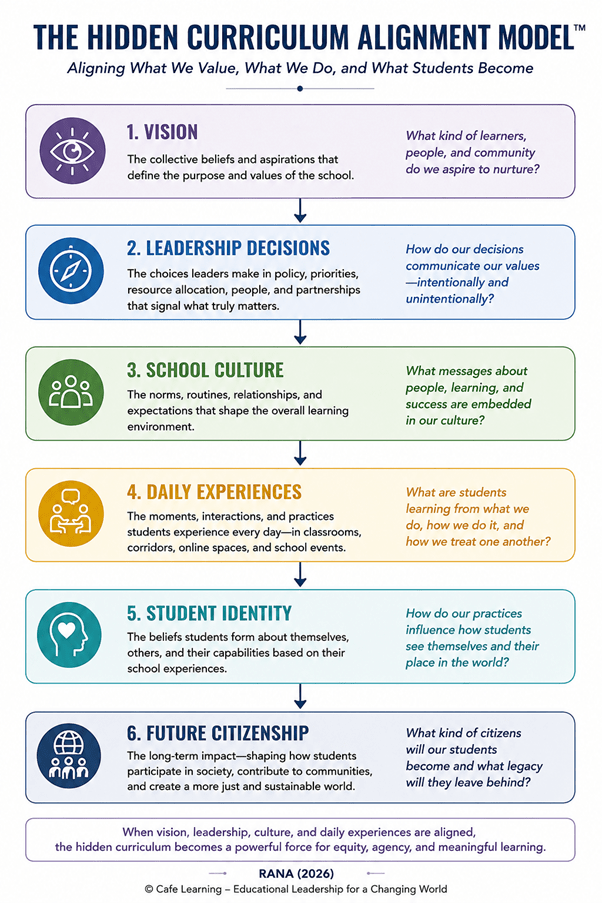
Reimagining School Culture: Why the Hidden Curriculum Is Ultimately a Leadership Responsibility
It is tempting to view the hidden curriculum as an inevitable by-product of schooling—an invisible force that simply evolves over time as students and teachers interact. Yet this perspective overlooks one of the most fundamental realities of educational leadership: school culture is not accidental. It is continuously designed, reinforced, and transformed through leadership decisions. Whether intentionally or unintentionally, leaders shape the conditions in which the hidden curriculum develops.
Educational reform has traditionally concentrated on improving what schools teach. Governments revise curriculum frameworks, introduce new assessment systems, invest in educational technology, and establish increasingly sophisticated accountability mechanisms. While these reforms undoubtedly influence educational quality, they often fail to address an equally important question: What kind of human beings is the school culture encouraging students to become?
This distinction is particularly significant because students spend thousands of hours immersed within the social and organisational life of their schools. During this time, they are not merely acquiring academic knowledge; they are constructing beliefs about authority, justice, collaboration, resilience, diversity, leadership, and citizenship. These beliefs emerge through lived experience rather than formal instruction. Consequently, the hidden curriculum should not be understood as a classroom phenomenon alone. It is an organisational phenomenon that reflects the values embedded within the entire educational ecosystem.
Educational change scholar Michael Fullan has long argued that meaningful school improvement depends less on isolated initiatives than on transforming the culture in which teaching and learning occur. Sustainable improvement cannot be achieved simply by introducing new programmes if the underlying assumptions, relationships, and organisational norms remain unchanged. Similarly, Andy Hargreaves reminds us that educational excellence and educational equity are inseparable; schools flourish when professional cultures encourage collaboration, trust, shared responsibility, and continuous learning rather than compliance and individual competition.
Viewed through this lens, the hidden curriculum becomes a mirror reflecting leadership priorities. Leaders communicate institutional values not only through strategic plans or policy statements but also through the countless decisions they make each day. The questions they ask during classroom observations, the behaviours they recognise during assemblies, the professional learning opportunities they prioritise, the voices they invite into decision-making, and the manner in which they respond to conflict all contribute to the educational messages students ultimately receive.
Consider, for example, a school that publicly promotes innovation while discouraging teachers from experimenting with new instructional approaches because examination performance is perceived as the only meaningful indicator of success. Alternatively, imagine a school that celebrates student well-being in its mission statement yet organises schedules, assessment practices, and communication structures in ways that leave little room for reflection, creativity, or meaningful relationships. In both cases, the formal curriculum advocates one set of values while the hidden curriculum quietly reinforces another. Students rarely struggle to identify which message reflects the institution’s genuine priorities.
This is why leadership authenticity has become increasingly important in contemporary education. Organisational psychologists frequently distinguish between espoused values—the principles institutions claim to uphold—and enacted values—the principles consistently demonstrated through everyday practice. The hidden curriculum exists precisely within the space between these two realities. The wider that gap becomes, the more likely students are to perceive educational values as symbolic rhetoric rather than lived commitments.
Reimagining the hidden curriculum therefore requires educational leaders to move beyond managing systems toward intentionally shaping culture. This demands a different set of leadership questions. Rather than asking whether curriculum standards have been covered, leaders might ask whether classroom interactions genuinely encourage intellectual curiosity. Instead of measuring participation solely through attendance or examination performance, they might examine whether every learner experiences a meaningful sense of belonging, psychological safety, and academic challenge. Rather than viewing professional development as the transmission of new instructional techniques, leaders can position it as an opportunity to collectively examine the implicit values communicated through teaching practices, organisational routines, and institutional traditions.
Such an approach aligns closely with contemporary understandings of learning organisations, where improvement is driven by continuous reflection rather than episodic reform. It also recognises that educational leadership is fundamentally an ethical endeavour. Every policy, procedure, and organisational norm communicates assumptions about what is important, whose contributions matter, and how communities should function. Leadership therefore extends beyond administrative efficiency; it becomes an ongoing process of designing environments where institutional culture consistently reinforces the educational ideals the school seeks to cultivate.
Ultimately, the hidden curriculum invites leaders to reconsider the legacy of their work. Long after strategic plans have been revised and curriculum documents replaced, the culture established within a school continues to shape the lives of those who passed through it. Students may not remember every lesson they studied, but they rarely forget whether their school taught them to ask thoughtful questions, respect diverse perspectives, embrace intellectual challenge, and believe that their voice mattered. Those lessons are not incidental outcomes of schooling; they are among its most enduring achievements. Recognising this truth transforms the hidden curriculum from an invisible influence into one of the most important responsibilities of educational leadership.
From Awareness to Action: Practical Strategies for Aligning the Hidden Curriculum with Educational Values
Recognising the hidden curriculum is only the beginning. The greater challenge lies in ensuring that the daily experiences of students consistently reinforce the educational values a school seeks to promote. This process does not require a complete institutional overhaul. More often, it demands a deliberate examination of the routines, relationships, and organisational practices that quietly shape school culture. Sustainable change begins when leaders and teachers become intentional about the messages embedded within everyday learning environments.
One of the most effective starting points is to observe the school through the eyes of a student. Educational leaders routinely analyse examination results, attendance data, and classroom observations, yet they less frequently ask how students actually experience the culture of the school. Walking through corridors, sitting in classrooms, attending assemblies, or listening to informal conversations from the perspective of a learner can reveal powerful insights. Whose achievements are publicly celebrated? Which behaviours receive the greatest attention? Where do students experience genuine autonomy, and where are they expected merely to comply? Such observations often expose hidden patterns that formal evaluation frameworks overlook.
Equally important is cultivating a culture in which student voice becomes a source of institutional learning rather than symbolic consultation. Many schools establish councils, suggestion boxes, or feedback surveys, yet students quickly distinguish between opportunities to express opinions and opportunities to influence meaningful decisions. Inviting learners to participate in curriculum discussions, school improvement initiatives, peer mentoring programmes, and the development of behavioural expectations communicates that their perspectives are valued as intellectual and civic contributions rather than procedural formalities. When students experience authentic participation, schools reinforce the democratic principles they aspire to teach.
Teachers also play a central role in shaping the hidden curriculum through the countless instructional decisions made each day. The questions teachers ask, the feedback they provide, the examples they select, and the classroom norms they establish all communicate assumptions about learning and human potential. Purposefully varying participation strategies, recognising different forms of excellence, encouraging intellectual risk-taking, and designing assessments that value creativity alongside accuracy help create classrooms where every learner has opportunities to contribute meaningfully. In this sense, inclusive pedagogy is not merely an instructional approach; it is a mechanism for reshaping the hidden curriculum itself.
Professional learning should likewise extend beyond instructional techniques to include critical reflection on organisational culture. Collaborative discussions among educators can explore questions that are rarely addressed during traditional professional development. What implicit messages do our assessment practices communicate? Which students consistently receive leadership opportunities? How do our disciplinary approaches influence learners’ perceptions of fairness and belonging? Which cultural assumptions remain invisible because they have become institutional habits? Reflective dialogue of this nature transforms professional development from the acquisition of new strategies into a process of organisational learning.
Another important consideration is the alignment between institutional values and institutional systems. Schools frequently articulate ambitious commitments to collaboration, innovation, inclusion, and student well-being. These aspirations, however, must be reflected in recruitment practices, performance evaluations, curriculum planning, communication structures, and resource allocation. A school that values collaboration while rewarding only individual achievement, or that promotes creativity while discouraging experimentation, inadvertently communicates conflicting messages. Students and teachers alike judge educational values by their consistent enactment rather than their presence within strategic plans.
The rapid integration of artificial intelligence and digital technologies introduces an additional dimension to this work. Educational leaders must now examine not only the cultural assumptions embedded within school traditions but also those embedded within digital learning environments. Adaptive learning platforms, automated assessment tools, and generative artificial intelligence increasingly influence how students engage with knowledge, receive feedback, and demonstrate understanding. Decisions regarding technology adoption should therefore be guided not solely by efficiency or innovation but also by careful consideration of the educational values these technologies reinforce. The hidden curriculum of the digital classroom deserves the same level of critical scrutiny as the hidden curriculum of the physical one.
Ultimately, aligning the hidden curriculum with institutional values is not a one-time initiative but a continuous process of reflection, dialogue, and refinement. School culture evolves through thousands of daily interactions rather than isolated reform projects. Each conversation, classroom routine, leadership decision, and organisational practice either strengthens or weakens the values the school seeks to embody. When leaders consciously design these experiences, the hidden curriculum becomes one of the most powerful instruments for advancing educational equity, learner agency, ethical leadership, and meaningful learning.
The most effective schools are therefore distinguished not simply by the quality of their formal curriculum but by the coherence between what they profess, what they practise, and what students ultimately experience. When these three dimensions become aligned, education moves beyond the transmission of knowledge toward the cultivation of thoughtful, compassionate, and critically engaged citizens prepared to contribute responsibly within an increasingly complex world.
Questions for Reflection
Educational transformation rarely begins with a new policy or a revised curriculum document. More often, it begins when educators are willing to examine the assumptions that have quietly shaped their schools for years. As you reflect on the hidden curriculum operating within your own educational context, consider the following questions individually or as part of leadership and professional learning discussions.
- If a visitor spent one week observing your school without reading its mission statement, what values would they conclude your institution truly prioritises?
- Beyond academic achievement, what does your school consistently communicate about intelligence, success, leadership, and human potential?
- Which students experience the strongest sense of belonging within your classrooms, and which learners may still be navigating the margins of the school community?
- Do your organisational routines encourage curiosity, collaboration, ethical decision-making, and intellectual risk-taking, or do they primarily reward compliance and predictability?
- How closely do your everyday practices align with the educational values your school publicly claims to uphold?
- If students remembered only the culture of your school twenty years from now, what would you hope they would say they learned about themselves, about others, and about the purpose of education?
Cafe Learning Reflection
Schools are often judged by their examination results, university admissions, or institutional rankings. These measures undoubtedly matter, but they capture only a portion of what education ultimately accomplishes. Every school also leaves behind an invisible legacy—a collection of beliefs, attitudes, habits, and assumptions that students carry into their families, workplaces, and communities long after graduation. That legacy is shaped not only by what educators intentionally teach, but by what students experience every day.
Perhaps this is why discussions about curriculum can never be confined to textbooks, standards, or assessment frameworks alone. Every interaction within a school communicates something about dignity, justice, belonging, responsibility, and possibility. Every organisational routine either strengthens or weakens the values an institution seeks to cultivate. Every leadership decision contributes to an educational story that extends far beyond the classroom.
The hidden curriculum therefore challenges educators to reconsider one of the most fundamental questions in educational leadership. Success cannot be measured solely by asking whether students mastered the prescribed curriculum. We must also ask whether the culture we created helped them become more thoughtful, more compassionate, more intellectually curious, and more prepared to contribute meaningfully to an increasingly interconnected world.
In the end, the most influential curriculum in any school may not be the one printed in official documents, but the one quietly written into the daily experiences of the people who learn, teach, and lead within it.
Selected References
Apple, M. W. (2004). Ideology and Curriculum (3rd ed.). Routledge.
Bandura, A. (1977). Social Learning Theory. Prentice Hall.
Bourdieu, P. (1977). Outline of a Theory of Practice. Cambridge University Press.
Fullan, M. (2020). Leading in a Culture of Change (2nd ed.). Jossey-Bass.
Giroux, H. A. (1983). Theory and Resistance in Education. Bergin & Garvey.
Hargreaves, A., & O’Connor, M. T. (2018). Collaborative Professionalism. Corwin.
Jackson, P. W. (1968). Life in Classrooms. Holt, Rinehart and Winston.
OECD. (2019). OECD Learning Compass 2030: A Series of Concept Notes.
Senge, P. M. (2006). The Fifth Discipline: The Art and Practice of the Learning Organization (Rev. ed.). Doubleday.
UNESCO. (2021). Reimagining Our Futures Together: A New Social Contract for Education.