The Assessment Paradox
Why Schools Continue to Measure Yesterday’s Success for Tomorrow’s World
Introduction
Education has always been shaped by a simple principle: what we assess is what learners ultimately value. Whether intentionally or not, assessment communicates the knowledge, skills, and behaviours that schools consider most important. Students quickly learn where to invest their effort—not by reading the school’s vision statement, but by understanding how success is measured.
This is precisely where one of education’s greatest paradoxes emerges.
Around the world, schools increasingly describe their aspirations in remarkably similar terms. They seek to develop critical thinkers, creative problem-solvers, effective communicators, ethical citizens, collaborative learners, and individuals capable of adapting to rapid technological and social change. Artificial intelligence, digital transformation, and the future of work have only accelerated this shift, prompting educators to emphasise competencies that extend far beyond the memorisation of information.
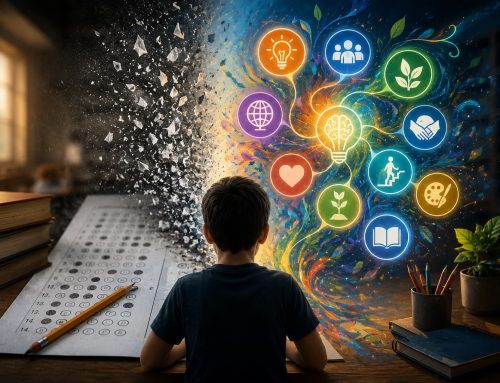
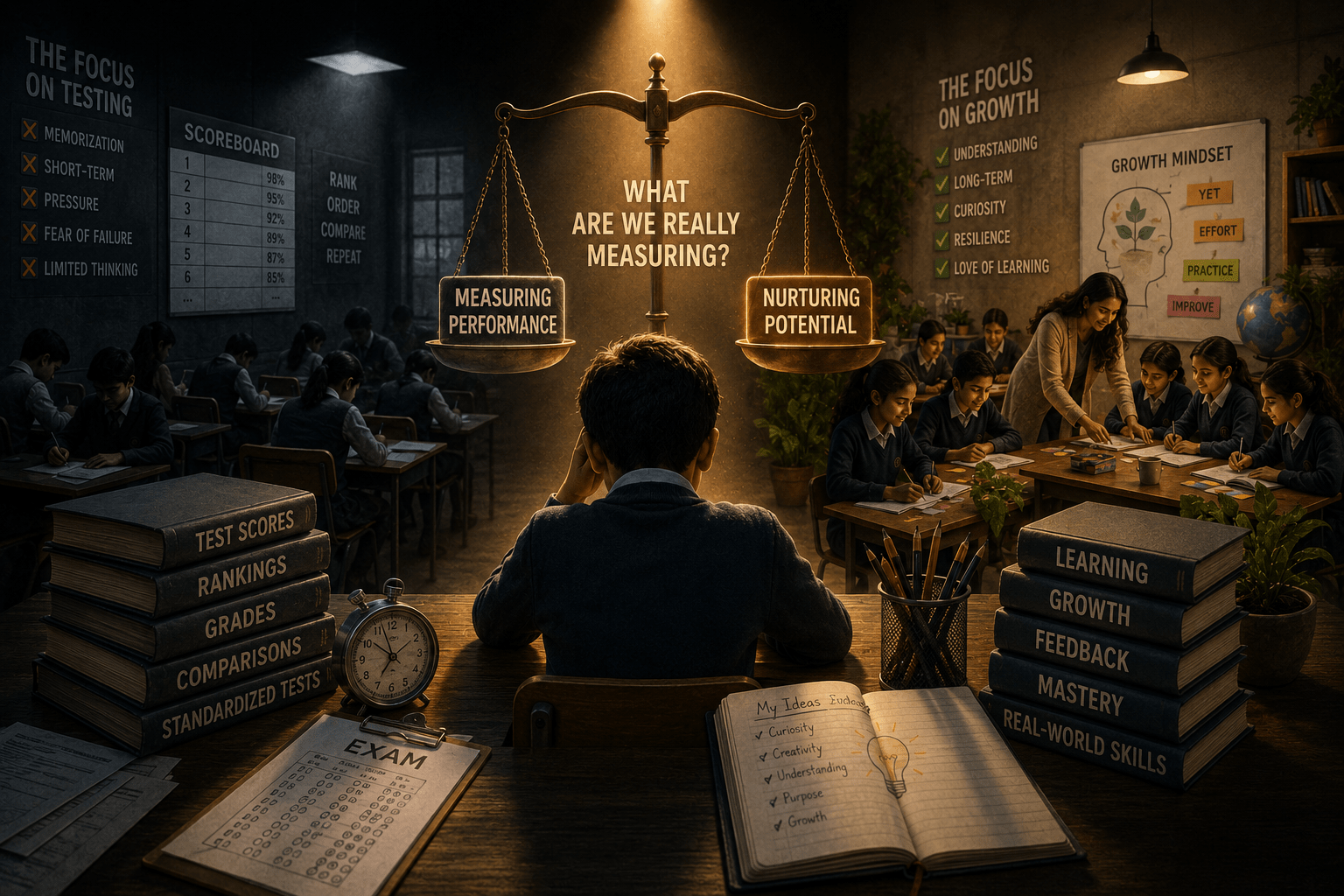
Yet the assessment systems used in many educational settings continue to reward a different set of capabilities. Success is still frequently determined by the accurate recall of content, procedural efficiency, individual performance under timed conditions, and the production of predetermined answers. In many classrooms, learners are encouraged to think creatively throughout the year but are evaluated primarily on their ability to reproduce established knowledge during examinations.
This contradiction matters because assessment does more than measure learning—it shapes it. Decades of educational research have consistently shown that assessment influences how students study, how teachers teach, how curricula are interpreted, and how schools define achievement. When assessment rewards memorisation, memorisation becomes the rational strategy. When it values inquiry, collaboration, reasoning, and authentic problem-solving, learning begins to reflect those priorities instead.
The emergence of generative artificial intelligence has made this challenge even more urgent. If machines can retrieve information, draft essays, solve routine problems, and generate explanations within seconds, the central question for education is no longer simply what students know. Increasingly, it is what students can understand, evaluate, create, apply, and ethically do with knowledge.
Perhaps the future of assessment is not about abandoning examinations or lowering academic standards. Rather, it is about ensuring that the evidence we collect genuinely reflects the capabilities learners will need to flourish in a world where information is abundant but human judgement, creativity, ethical reasoning, and adaptability have become increasingly valuable.
Assessment Is Never Neutral: It Defines What Learning Becomes
One of the most enduring misconceptions in education is that assessment merely evaluates learning. Contemporary educational research suggests something far more profound: assessment shapes learning itself. The methods through which schools evaluate students inevitably influence what teachers prioritise, how learners study, and ultimately what society comes to recognise as educational success. Assessment, therefore, is not a passive instrument of measurement; it is an active architect of learning.
This proposition is supported by decades of scholarship. Black and Wiliam’s seminal work on formative assessment demonstrated that assessment exerts one of the most powerful influences on student achievement, not simply because it records performance, but because it guides subsequent learning. Their research fundamentally shifted educational thinking by positioning assessment as an integral component of instruction rather than its final destination. Learning improves when assessment generates meaningful feedback, informs teaching, and enables learners to regulate their own progress.
Grant Wiggins extended this perspective through the concept of authentic assessment, arguing that meaningful evaluation should reflect the complexity of real-world performance rather than reward the isolated recall of information. If education seeks to prepare learners for professional, civic, and ethical life, assessment must examine whether students can transfer knowledge across unfamiliar contexts, solve complex problems, justify their reasoning, collaborate effectively, and exercise sound judgement under conditions of uncertainty. These are fundamentally different cognitive demands from selecting predetermined answers or reproducing memorised content.
More recently, the OECD Learning Compass 2030 has reinforced this shift by arguing that education should cultivate student agency, transformative competencies, and the capacity to create new value, reconcile tensions, and take responsible action. Such aspirations require assessment systems capable of capturing learning processes as well as learning products. Similarly, Linda Darling-Hammond’s work on performance assessment demonstrates that rich, authentic tasks provide deeper evidence of student understanding than traditional examinations alone because they require learners to synthesise knowledge, communicate ideas persuasively, and apply learning to complex situations.
These developments reveal a growing incongruity within contemporary education. While curricula increasingly advocate creativity, critical thinking, collaboration, ethical reasoning, and adaptability, assessment systems often remain anchored in epistemological assumptions inherited from an industrial model of schooling—one in which knowledge was comparatively scarce, expertise was largely stable, and educational success depended upon accurate recall and procedural fluency. In the age of generative artificial intelligence, those assumptions are becoming progressively more difficult to sustain.
This does not imply that factual knowledge has become obsolete. Cognitive science consistently demonstrates that deep understanding depends upon a well-organised knowledge base. However, knowledge alone is no longer sufficient. The educational challenge of the twenty-first century is increasingly epistemic rather than informational. Learners must distinguish credible evidence from misinformation, interrogate AI-generated content, synthesise diverse perspectives, exercise ethical judgement, and apply knowledge wisely within novel and often ambiguous contexts. These capabilities cannot be inferred solely from conventional examinations; they require richer and more sophisticated forms of assessment.
The assessment paradox, therefore, is not simply that schools continue to measure yesterday’s knowledge. It is that many systems continue to evaluate what is easiest to quantify rather than what is most consequential to cultivate. Until assessment evolves to recognise higher-order thinking, professional judgement, adaptive expertise, and human capability, educational reform will remain constrained by the very mechanisms intended to evaluate its success.
Beyond Examinations: Towards Evidence-Rich Assessment
The future of assessment is unlikely to be characterised by the complete disappearance of examinations. Traditional assessments will continue to serve important purposes, particularly when evaluating disciplinary knowledge, conceptual understanding, and certain forms of procedural competence. The more significant transformation lies elsewhere. Rather than relying on a single source of evidence, schools will increasingly need to construct a richer, more comprehensive picture of learning.
This represents a shift from assessment as an event to assessment as an evidence ecosystem.
In most educational systems, high-stakes decisions continue to depend disproportionately on performance during a limited number of examinations. Such an approach inevitably privileges what can be measured efficiently within restricted timeframes. Yet many of the capabilities now regarded as indispensable—including intellectual curiosity, ethical judgement, collaborative problem-solving, adaptive expertise, creativity, metacognition, and sustained inquiry—develop gradually and reveal themselves across diverse contexts rather than through isolated testing occasions.
Emerging research in competency-based education and learning sciences suggests that robust educational judgement should draw upon multiple forms of evidence. Performance assessments, long-term projects, digital portfolios, interdisciplinary investigations, structured observations, reflective writing, oral presentations, collaborative inquiry, and authentic problem-solving tasks each illuminate dimensions of learning that conventional examinations often overlook. Individually, these measures are incomplete. Collectively, they provide a more valid and nuanced representation of what learners know, understand, and are capable of doing.
Artificial intelligence further strengthens the case for evidence-rich assessment while simultaneously introducing new complexities. As AI systems become increasingly proficient at generating written responses, solving routine problems, and supporting content production, educators must distinguish between tasks that merely demonstrate access to information and those that reveal genuine understanding, intellectual independence, and ethical reasoning. This does not diminish the value of AI as a learning partner; rather, it elevates the importance of designing assessments that require learners to defend decisions, explain reasoning, critique evidence, synthesise multiple perspectives, and transfer knowledge to unfamiliar situations.
Assessment itself is also becoming more intelligent. Advances in learning analytics, adaptive assessment, and AI-supported feedback enable educators to identify patterns of learning that were previously difficult to observe. Used responsibly and transparently, these technologies can provide more timely feedback, support personalised learning pathways, and help teachers make more informed instructional decisions. Nevertheless, technological sophistication should never be mistaken for educational validity. The central question is not whether assessment becomes more digital, but whether it becomes more meaningful.
Perhaps the future of assessment will depend less on replacing one method with another and more on redefining what counts as credible evidence of learning. Future-ready education will require assessment systems capable of capturing not only what learners remember, but how they think, how they learn, how they collaborate, how they adapt, and how responsibly they apply their knowledge in an increasingly complex world. The schools that succeed will not necessarily be those that administer more assessments, but those that gather better evidence about human capability.
From Insight to Action
Reimagining assessment does not require abandoning academic rigour or replacing every examination with projects and portfolios. Rather, it demands a more sophisticated understanding of what constitutes meaningful evidence of learning. Future-ready education will depend on assessment systems that are intellectually rigorous, educationally authentic, and aligned with the capabilities learners will need beyond school.
1. Align Assessment with Your Educational Vision
Every school should periodically ask a deceptively simple question:
Do our assessments measure the capabilities we claim to value?
If your vision emphasises creativity, critical thinking, collaboration, ethical reasoning, or learner agency, these competencies should be visible within your assessment framework—not merely within curriculum documents or mission statements. Misalignment between educational aspirations and assessment practices inevitably produces contradictory learning behaviours.
2. Diversify the Evidence of Learning
No single assessment can capture the complexity of human learning. Develop balanced assessment systems that combine examinations with authentic performance tasks, portfolios, research projects, oral defences, reflective journals, collaborative investigations, and real-world problem-solving experiences. The objective is not to increase assessment volume, but to improve the validity and richness of the evidence collected.
3. Assess Thinking, Not Simply Answers
Artificial intelligence has fundamentally altered the educational value of routine information retrieval. Increasingly, assessments should require learners to explain their reasoning, defend conclusions with evidence, critique competing perspectives, transfer knowledge across unfamiliar contexts, and reflect on their decision-making processes. These forms of cognitive performance are considerably more resistant to automation and provide deeper insight into genuine understanding.
4. Use Assessment to Develop Learning, Not Merely Certify It
Assessment should function as a continuous dialogue between teaching and learning rather than a terminal judgement of performance. High-quality feedback, opportunities for revision, structured self-assessment, and peer review cultivate metacognition, resilience, and learner autonomy. When students understand assessment as part of learning rather than the conclusion of learning, achievement becomes more sustainable and meaningful.
5. Build Assessment Literacy Across the School Community
Meaningful reform depends not only on new assessment methods but also on shared understanding. Teachers require ongoing professional learning in assessment design and interpretation. Students should understand why different forms of evidence matter. Parents need opportunities to appreciate assessment beyond examination scores. Educational leaders, in turn, must ensure that policy, reporting systems, and accountability structures reinforce rather than undermine these principles.
Assessment Reflection Challenge
Review one assessment currently used in your school or classroom and ask the following questions:
- What capability is this assessment actually measuring?
- Does it reflect the kind of learner we hope to develop?
- Could a student succeed simply through memorisation or AI-assisted content generation?
- What additional evidence would strengthen our confidence in this learner’s understanding?
- If this assessment were redesigned for 2035 rather than 2025, what would remain unchanged—and what would need to evolve?
The future of assessment will not be determined by how efficiently we measure learning. It will be determined by how wisely we define it.
Cafe Learning Reflection
Throughout history, every education system has been defined not only by what it teaches, but by what it chooses to measure. Assessment has never been a neutral administrative process. It reflects our beliefs about intelligence, success, capability, and ultimately about what it means to be educated.
Today, education stands at an inflection point. Artificial intelligence has fundamentally altered humanity’s relationship with knowledge. Information is no longer scarce, and routine cognitive tasks are increasingly shared with intelligent technologies. Yet the qualities that make us distinctly human—curiosity, discernment, creativity, ethical judgement, empathy, adaptability, and wisdom—have become more valuable than ever. Ironically, these are often the very capabilities that remain the most difficult to assess through conventional methods.
Perhaps the greatest challenge facing education is not that our assessment systems are failing, but that many were designed for a world that no longer exists. They emerged during an era that prized standardisation, predictability, and efficiency. The world our learners are entering demands something different: the capacity to navigate ambiguity, collaborate across disciplines and cultures, evaluate competing sources of information, work responsibly with artificial intelligence, and continue learning throughout their lives.
This does not diminish the importance of academic knowledge. On the contrary, deep knowledge remains the foundation upon which critical thinking, creativity, and innovation are built. The challenge is to ensure that assessment captures not only what learners know, but also how they think, how they apply knowledge, how they grow, and how responsibly they use their understanding to improve the world around them.
Ultimately, the future of assessment is not about replacing examinations with new techniques or adopting technology for its own sake. It is about asking a more profound educational question:
If assessment defines success, are we measuring the kind of success humanity will need in the decades ahead?
The answer to that question may shape not only the future of assessment, but the future of education itself.
Selected References
Black, P., & Wiliam, D. (1998). Inside the Black Box: Raising Standards Through Classroom Assessment. King’s College London, School of Education.
Darling-Hammond, L., Hyler, M. E., & Gardner, M. (2017). Effective Teacher Professional Development. Learning Policy Institute.
Darling-Hammond, L., Flook, L., Cook-Harvey, C., Barron, B., & Osher, D. (2020). Implications for Educational Practice of the Science of Learning and Development. Applied Developmental Science, 24(2), 97–140.
National Research Council. (2012). Education for Life and Work: Developing Transferable Knowledge and Skills in the 21st Century. National Academies Press.
OECD. (2019). OECD Learning Compass 2030: A Series of Concept Notes. OECD Publishing.
UNESCO. (2023). Guidance for Generative AI in Education and Research. UNESCO Publishing.
Wiggins, G. (1998). Educative Assessment: Designing Assessments to Inform and Improve Student Performance. Jossey-Bass.
Wiliam, D. (2011). Embedded Formative Assessment. Solution Tree Press.
World Economic Forum. (2025). The Future of Jobs Report 2025. World Economic Forum.