

Beyond Test Scores: Rethinking What Schools Should Measure in the Twenty-First Century
Why Academic Achievement Alone Is No Longer Enough to Define Educational Success
Introduction
During classroom observations and school visits over the years, I have often encountered an interesting paradox. Two schools may report remarkably similar examination results, comparable pass rates, and almost identical academic performance. Yet the learning environments they cultivate can feel fundamentally different. In one school, students confidently ask questions, collaborate with their peers, demonstrate curiosity, and willingly embrace challenging tasks. In the other, learners remain hesitant to participate, avoid making mistakes, and measure success primarily by their ability to reproduce correct answers during examinations.
If both schools produce similar grades, can we confidently conclude that they are equally successful?
This question lies at the heart of one of the most significant conversations in contemporary education. For decades, educational quality has been evaluated predominantly through measurable academic outcomes such as standardized test scores, board examination results, graduation rates, and university admissions. These indicators undoubtedly provide valuable information about student achievement and institutional performance. However, they offer only a partial picture of what schools are actually accomplishing.
The world students are preparing to enter is increasingly characterised by artificial intelligence, automation, global interdependence, rapidly evolving labour markets, and unprecedented social complexity. Success within such a landscape depends not only upon subject knowledge but also upon critical thinking, adaptability, collaboration, ethical reasoning, creativity, communication, resilience, and lifelong learning. These competencies have become central to international education frameworks developed by organisations such as the OECD, UNESCO, the World Economic Forum, and numerous national curriculum authorities. Yet many of these attributes remain largely invisible within traditional assessment systems.
This growing disconnect raises an important challenge for educational leaders. If schools continue measuring only what is easiest to quantify, they risk overlooking many of the capabilities that matter most for students’ long-term success. Assessment shapes educational priorities. What schools choose to measure inevitably influences what teachers emphasise, what students value, and how parents define achievement. In this sense, assessment is never merely a reporting mechanism; it is one of the most powerful drivers of educational culture.
This does not imply that examination results should be dismissed or that academic standards have become less important. On the contrary, academic excellence remains an essential objective of schooling. The challenge is not to replace academic achievement but to situate it within a broader understanding of learner development. The central question is therefore no longer whether schools should assess academic performance, but whether academic performance alone provides an adequate representation of educational success.
As educational philosopher John Dewey argued more than a century ago, education should prepare individuals not merely to accumulate knowledge but to participate thoughtfully in democratic society. More recently, the OECD’s Learning Compass 2030 has similarly emphasised learner agency, well-being, and transformative competencies as essential outcomes for future-ready education systems. Together, these perspectives remind us that schools are responsible not only for what students know, but also for who they become.
Perhaps, then, the most pressing question confronting educational leaders today is not “How can we improve test scores?” but rather “What evidence would convince us that our students are truly prepared for life beyond school?”
The answer to that question may fundamentally reshape how we define educational excellence in the twenty-first century.
Why Test Scores Became the Dominant Measure of Educational Success
To understand why educational systems continue to rely so heavily on examination results, it is important to recognise that standardized assessment did not emerge without purpose. Historically, test scores offered schools and policymakers an objective, scalable, and comparatively efficient method for evaluating student learning. As education systems expanded during the twentieth century, governments required common benchmarks to monitor achievement, allocate resources, certify qualifications, and promote accountability across increasingly diverse school populations.
From this perspective, standardized testing addressed several important educational needs. It provided measurable evidence of student progress, established consistent academic expectations, and enabled comparisons across schools, districts, and even nations. International assessments such as the Programme for International Student Assessment (PISA) further strengthened this approach by offering governments valuable insights into national education systems and encouraging data-informed policy reform. In many respects, assessment became synonymous with accountability, and accountability became synonymous with educational quality.
This emphasis on measurable outcomes also reflected broader societal expectations. Parents sought evidence that schools were preparing children for higher education and employment. Universities required reliable mechanisms for student selection. Employers valued qualifications that appeared comparable across different educational contexts. Consequently, examination performance evolved into a widely accepted indicator of academic success, institutional effectiveness, and even national competitiveness.
The challenge, however, is that educational priorities have changed more rapidly than many assessment systems. The contemporary world demands capabilities that extend well beyond the recall of information or the reproduction of predetermined answers. While examinations remain effective for assessing aspects of subject knowledge, they often struggle to capture complex human competencies such as creativity, ethical reasoning, intercultural understanding, collaboration, resilience, curiosity, learner agency, and adaptive problem-solving. These capabilities are increasingly recognised as essential for success in higher education, the workplace, civic life, and lifelong learning.
Educational research has repeatedly demonstrated that assessment influences behaviour. Teachers naturally devote greater instructional attention to what will be assessed, students concentrate their efforts on what will be rewarded, and schools allocate resources toward indicators that determine public accountability. This phenomenon—often described as “what gets measured gets valued”—illustrates why assessment systems possess extraordinary influence over curriculum, pedagogy, and school culture. When examination results become the dominant measure of success, they inevitably shape not only what students learn but also how they learn and why they learn.
Scholars such as Paul Black and Dylan Wiliam, through their influential work on Assessment for Learning, argue that assessment should function not merely as a mechanism for evaluating learning but as an integral part of the learning process itself. Similarly, John Hattie’s synthesis of educational research highlights the importance of formative feedback, self-assessment, and visible learning in promoting deeper understanding rather than surface-level performance. These perspectives do not reject assessment; rather, they advocate for assessment systems that support learning, reflection, and continuous improvement instead of serving exclusively as instruments of ranking and certification.
International organisations have reached similar conclusions. The OECD Learning Compass 2030 emphasises learner agency, transformative competencies, and student well-being alongside academic achievement, while UNESCO’s Futures of Education initiative argues that education must prepare learners to navigate uncertainty, contribute ethically to society, and address complex global challenges. These frameworks reflect a growing international consensus: although academic knowledge remains indispensable, it is no longer sufficient on its own.
This shift does not diminish the importance of rigorous academic standards. Rather, it invites educational leaders to ask a more sophisticated question. Instead of asking whether schools should assess academic achievement, we should ask whether our current assessment systems capture the full range of knowledge, skills, dispositions, and values that define an educated person in the twenty-first century.
That question marks the beginning of a new conversation—one that moves beyond measuring educational performance toward understanding whole-learner development. It is within this broader perspective that schools can begin redefining what meaningful assessment should look like in the decades ahead.
The Whole-Learner Assessment Framework: A More Comprehensive Vision of Educational Success
If assessment shapes educational priorities, then the question of what we choose to measure becomes one of the most consequential decisions any school can make. Assessment does far more than evaluate learning; it communicates institutional values. It tells students what their school considers important, influences how teachers design instruction, and ultimately shapes the culture of learning itself.
Traditional assessment systems have undoubtedly strengthened educational accountability by providing measurable evidence of academic achievement. However, they often privilege those aspects of learning that are easiest to quantify while overlooking equally important dimensions of human development. As schools prepare learners for an increasingly complex, technology-driven, and interconnected world, there is a growing need for assessment systems that recognise the full breadth of educational outcomes rather than reducing success to examination performance alone.
To address this challenge, I propose the Whole-Learner Assessment Framework (WLAF)—a conceptual model that positions academic achievement as one essential component within a broader ecosystem of learner development. Rather than replacing traditional assessment, the framework encourages educational leaders to expand their understanding of what meaningful evidence of learning should include.
The Whole-Learner Assessment Framework (WLAF)
At the centre of the framework lies Academic Achievement, recognising that disciplinary knowledge, literacy, numeracy, and conceptual understanding remain indispensable foundations of education. Surrounding this central dimension are six interconnected domains that together provide a more holistic representation of learner success.
- Critical Thinking
Students should be assessed not only on what they know but also on how effectively they analyse information, evaluate evidence, solve unfamiliar problems, and construct well-reasoned arguments. In an age increasingly shaped by artificial intelligence and abundant digital information, the ability to think critically has become more valuable than the ability to memorise isolated facts.
- Collaboration
Modern workplaces and communities depend upon teamwork, communication, and collective problem-solving. Schools therefore have a responsibility to evaluate students’ capacity to work productively with others, contribute responsibly within groups, resolve disagreements constructively, and appreciate diverse perspectives. Collaborative competence is no longer an optional interpersonal skill; it is an essential educational outcome.
- Learner Agency
Future-ready education requires students who can set meaningful goals, monitor their own progress, make informed decisions, and take increasing responsibility for their learning. Assessment should therefore recognise self-regulation, initiative, reflection, and independent learning alongside traditional academic performance. Learner agency transforms students from passive recipients of instruction into active participants in their own educational journeys.
- Creativity and Innovation
While knowledge remains fundamental, future societies will increasingly value the capacity to generate new ideas, adapt existing knowledge to unfamiliar contexts, and approach complex challenges with imagination and flexibility. Authentic assessment should therefore provide opportunities for students to design, create, investigate, and innovate rather than simply reproduce predetermined answers.
- Well-being and Resilience
Academic excellence cannot be sustained without emotional well-being. Learners who develop resilience, emotional regulation, adaptability, and healthy relationships are better equipped to navigate uncertainty, overcome setbacks, and continue learning throughout their lives. Schools should therefore view student well-being not as an additional programme but as an integral dimension of educational success.
- Ethical Citizenship
Education ultimately prepares individuals to participate responsibly within society. Assessment should therefore acknowledge students’ capacity to demonstrate empathy, integrity, intercultural understanding, environmental responsibility, civic engagement, and ethical decision-making. These dispositions are fundamental to democratic participation and global citizenship, yet they remain largely invisible within conventional examination systems.
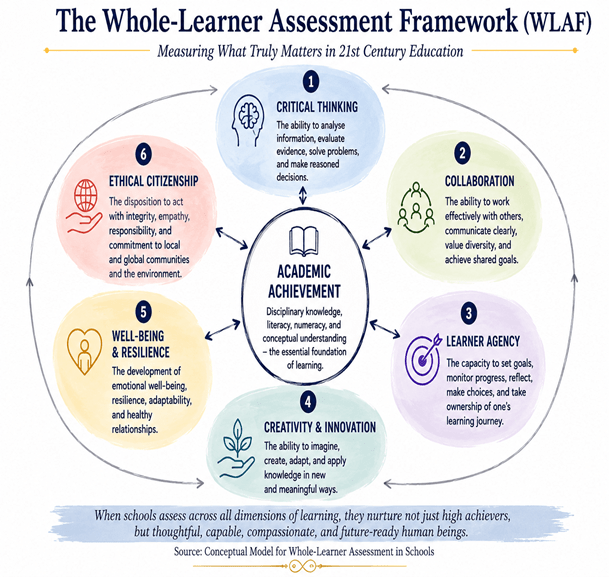
Figure 1. The Whole-Learner Assessment Framework (WLAF): A conceptual model positioning academic achievement within six interconnected dimensions of learner development.
Source: Developed by the author.
The strength of the Whole-Learner Assessment Framework lies not in treating these dimensions as separate competencies but in recognising their interdependence. A student may demonstrate exceptional academic knowledge yet struggle to collaborate effectively. Another may excel in creative problem-solving while requiring additional support in self-regulation. Genuine educational excellence emerges when schools intentionally cultivate balanced development across these interconnected domains rather than pursuing academic performance in isolation.
Importantly, this framework is not intended to replace examinations or academic standards. Instead, it complements existing assessment systems by encouraging schools to gather richer evidence of student growth through portfolios, inquiry projects, collaborative investigations, student exhibitions, reflective journals, presentations, peer assessment, self-assessment, community engagement, and authentic performance tasks. Such approaches provide a more comprehensive understanding of learning while preserving the rigour of academic expectations.
For educational leaders, the framework also serves as a strategic planning tool. It invites schools to ask a fundamental question: Does our assessment system reflect the kind of graduates we hope to develop? If the answer extends beyond examination success to include ethical leadership, creativity, resilience, collaboration, and learner agency, then assessment practices must evolve accordingly. What schools choose to assess ultimately communicates what they believe education is for.
The future of educational assessment will not be defined by abandoning academic excellence but by recognising that excellence itself has become multidimensional. Preparing students for the twenty-first century requires schools to value not only what learners know, but also how they think, how they collaborate, how they adapt, and how they contribute to the communities they will one day lead.
Implications for Educational Leaders: Aligning Assessment with Educational Purpose
Reimagining assessment is not simply a matter of introducing new reporting formats or adding additional evaluation tools. It requires educational leaders to reconsider one of the most fundamental questions in school improvement: Does our assessment system reflect the kind of learners we aspire to develop? Assessment is ultimately a leadership decision because it shapes organisational priorities, influences instructional practice, and communicates institutional values more powerfully than many strategic plans.
School leaders therefore have a responsibility to ensure that assessment extends beyond measuring academic attainment to capturing meaningful evidence of learner growth. This begins by encouraging teachers to integrate authentic assessment practices such as inquiry projects, portfolios, presentations, collaborative investigations, student exhibitions, reflective journals, and performance-based tasks alongside traditional examinations. Such approaches allow students to demonstrate not only what they know, but how they think, solve problems, communicate ideas, and apply knowledge in meaningful contexts.
Professional learning also plays a critical role in this transformation. Teachers require opportunities to develop assessment literacy, design high-quality formative assessments, interpret evidence of learning, and provide feedback that promotes continuous improvement rather than merely judging performance. When assessment is viewed as an integral component of learning rather than the conclusion of learning, classrooms become environments where reflection, curiosity, and growth are consistently encouraged.
Equally important is ensuring that school reporting systems communicate a balanced picture of student development. Parents and learners deserve feedback that recognises academic achievement while also acknowledging progress in collaboration, creativity, learner agency, ethical responsibility, resilience, and well-being. Such reporting reinforces the message that education values the development of the whole learner rather than isolated examination performance.
Ultimately, meaningful assessment reform is not achieved by measuring more; it is achieved by measuring what matters. Educational leaders who intentionally align assessment with the broader purposes of education create learning environments where academic excellence and human development are understood not as competing priorities, but as complementary dimensions of educational success.
Cafe Learning Reflection
Perhaps the greatest limitation of contemporary assessment is not that it measures too much, but that it often measures too little. Schools have become increasingly sophisticated in evaluating what students remember, yet many of the qualities that define thoughtful, ethical, creative, and resilient individuals remain difficult to capture within conventional grading systems. The danger is not that examinations exist, but that they gradually become mistaken for education itself.
If assessment communicates what schools value, then every report card tells a story about our educational priorities. It reveals whether we view learners primarily as test-takers or as developing human beings capable of inquiry, collaboration, innovation, compassion, and responsible citizenship. Expanding assessment therefore represents more than a technical reform; it reflects a philosophical commitment to a richer understanding of learning.
As education continues to evolve in an era shaped by artificial intelligence, global interconnectedness, and continuous change, perhaps the question is no longer whether students can achieve high grades. A more meaningful question is whether our assessment systems recognise the full range of capabilities that will enable them to thrive long after formal schooling has ended.
Educational excellence is ultimately measured not only by the qualifications students receive, but by the kind of people they become.
Selected References
Black, P., & Wiliam, D. (1998). Assessment and Classroom Learning. Assessment in Education: Principles, Policy & Practice, 5(1), 7–74.
Darling-Hammond, L., Flook, L., Cook-Harvey, C., Barron, B., & Osher, D. (2020). Implications for Educational Practice of the Science of Learning and Development. Applied Developmental Science, 24(2), 97–140.
Dewey, J. (1916). Democracy and Education. Macmillan.
Fullan, M. (2020). Leading in a Culture of Change (2nd ed.). Jossey-Bass.
Hattie, J. (2009). Visible Learning. Routledge.
OECD. (2019). OECD Learning Compass 2030: A Series of Concept Notes.
Pellegrino, J. W. (2014). Assessment as a Positive Influence on 21st Century Teaching and Learning. Educational Testing Service.
Stiggins, R. (2005). From Formative Assessment to Assessment FOR Learning: A Path to Success in Standards-Based Schools. Phi Delta Kappan, 87(4), 324–328.
UNESCO. (2021). Reimagining Our Futures Together: A New Social Contract for Education.
Wiggins, G. (1998). Educative Assessment: Designing Assessments to Inform and Improve Student Performance. Jossey-Bass.