The Difference Between Schooling and Education
Why One Delivers Knowledge While the Other Shapes Human Beings
Introduction
The words schooling and education are often used interchangeably, yet they do not mean the same thing. In everyday conversation, educational policies, institutional reforms, and public debates frequently blur the distinction between the two, creating the impression that attending school is synonymous with becoming educated. While schooling can certainly contribute to education, the relationship is neither automatic nor complete. One is an institutional process; the other is a lifelong transformation.
This distinction has become increasingly important in the twenty-first century. Around the world, governments invest heavily in schools, curriculum reforms, digital technologies, and assessment systems with the aim of improving educational outcomes. These efforts have expanded access to learning for millions of students and have contributed significantly to literacy, economic development, and social mobility. Yet a fundamental question remains: Does more schooling necessarily produce more educated individuals?
History suggests a more nuanced answer. It is entirely possible to complete years of formal schooling while remaining intellectually incurious, ethically disengaged, or unable to think critically about complex issues. Conversely, many of history’s most influential thinkers regarded education as a continuous process of inquiry that extended far beyond the walls of any classroom. This observation does not diminish the importance of schools. Rather, it challenges us to distinguish between the structures that organise learning and the deeper transformation that learning is intended to achieve.
Understanding this difference has become even more significant in an age of artificial intelligence, rapid technological change, and global uncertainty. When information is instantly accessible and knowledge evolves continuously, the purpose of education cannot be limited to transmitting facts alone. Schools remain essential institutions, but education must ultimately prepare individuals not only to know more, but also to think more wisely, act more ethically, and continue learning throughout their lives.
Perhaps the most important question is not whether students spend enough years in school, but whether those years help them become more thoughtful, more compassionate, more discerning, and more capable of contributing meaningfully to society. The answer to that question begins by recognising that schooling and education, while closely connected, are fundamentally different ideas.
Schooling Organises Learning; Education Transforms the Learner
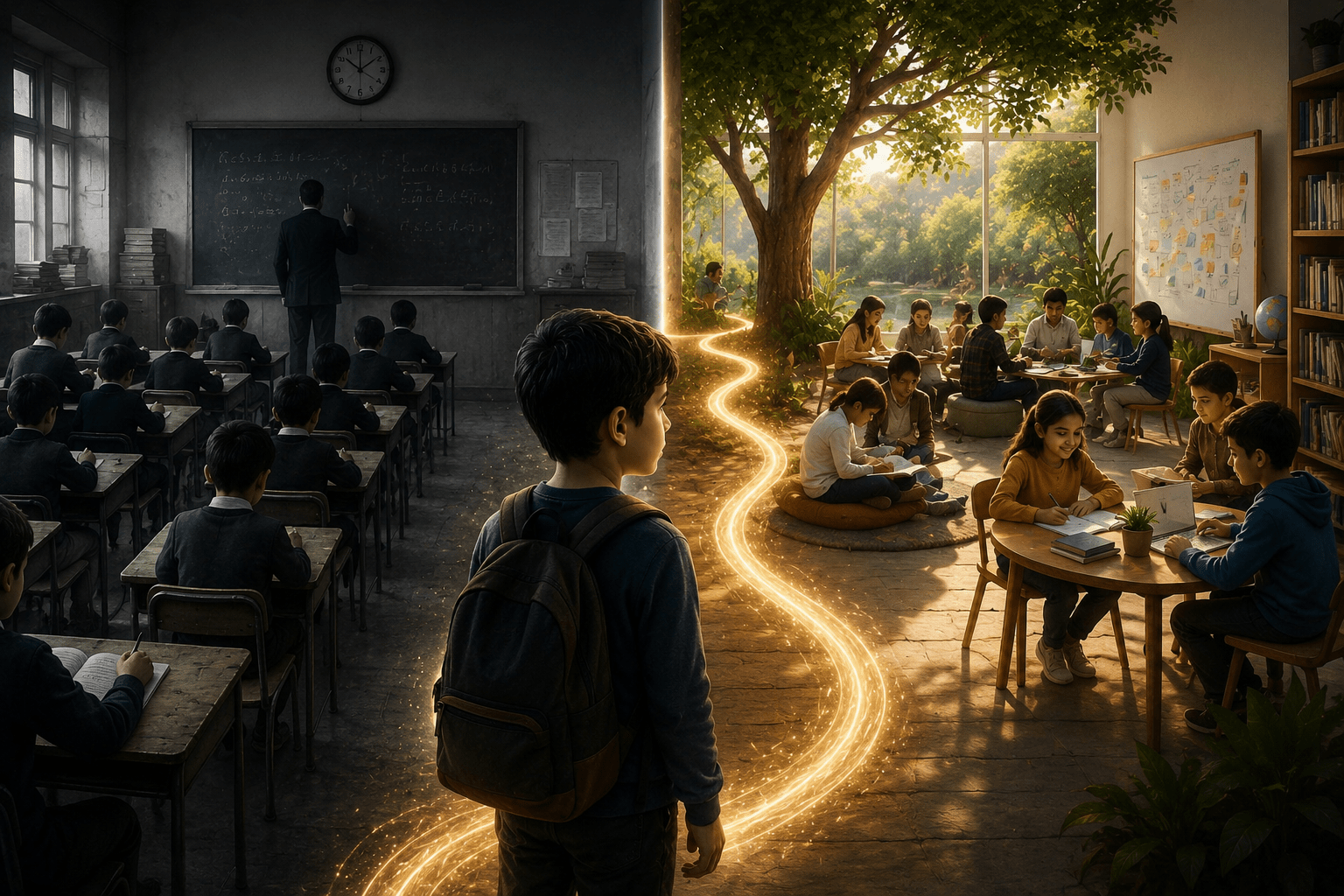
Schooling and education are closely related, but they serve different purposes. Schooling refers to the formal structures through which societies organise learning. It includes institutions, curricula, timetables, examinations, qualifications, and systems of accountability. Schooling provides learners with access to knowledge, develops foundational academic skills, and creates opportunities for intellectual and social development within a structured environment. It is, in essence, the organised framework through which education is intended to occur.
Education, however, extends far beyond those institutional structures. It is the ongoing process through which individuals develop intellectually, ethically, emotionally, and socially throughout their lives. Education influences how people interpret the world, make decisions, relate to others, evaluate evidence, and define their responsibilities as members of society. While schooling often has a beginning and an end, education continues wherever meaningful learning takes place—in families, communities, workplaces, books, travel, professional experiences, and reflective engagement with life itself.
The distinction becomes particularly clear when we consider their respective outcomes. Successful schooling may result in certificates, qualifications, and academic achievement. Successful education, by contrast, is reflected in qualities that cannot always be measured through examinations alone: sound judgement, intellectual curiosity, ethical reasoning, empathy, resilience, and the capacity to continue learning in unfamiliar circumstances. These attributes emerge not simply from exposure to information but from the thoughtful application of knowledge to real human experiences.
This distinction does not imply that schooling and education are in opposition. On the contrary, effective schooling should create the conditions through which genuine education can flourish. A rigorous curriculum, knowledgeable teachers, meaningful assessment, and supportive learning environments all contribute significantly to educational growth. The challenge arises only when the structures of schooling become mistaken for the purpose of education itself. When examination performance, curriculum completion, or institutional efficiency become ends rather than means, schools risk measuring educational success without fully achieving educational transformation.
The emergence of artificial intelligence further reinforces this distinction. If intelligent technologies can increasingly provide information, generate explanations, and automate routine cognitive tasks, then the unique contribution of education lies not merely in helping students acquire knowledge but in helping them develop the wisdom to use that knowledge responsibly. Schooling may organise access to information; education cultivates the judgement required to interpret, question, and apply it wisely.
Perhaps the simplest way to understand the difference is this: schooling equips students with knowledge, while education shapes the kind of people they become. The most successful schools are therefore those that recognise these two purposes not as competing priorities but as inseparable dimensions of meaningful learning.
When Schooling Serves Education
Recognising the distinction between schooling and education does not require schools to abandon examinations, curricula, or academic standards. These remain essential components of effective education systems. The challenge is not whether schools should organise learning, but whether every aspect of schooling ultimately serves the larger purpose of educating human beings rather than merely producing academic outcomes.
This shift begins with curriculum. A well-designed curriculum should certainly develop disciplinary knowledge, but it should also encourage students to ask meaningful questions, connect ideas across subjects, and understand how knowledge relates to the challenges of the wider world. Learning becomes more powerful when students appreciate not only what they are studying but also why it matters.
Assessment deserves similar reflection. While examinations provide valuable evidence of academic progress, they represent only one dimension of educational success. Schools should also create opportunities for learners to demonstrate judgement, creativity, collaboration, ethical reasoning, and problem-solving. These capacities are increasingly essential in contemporary society, yet they are not always visible through traditional assessment alone.
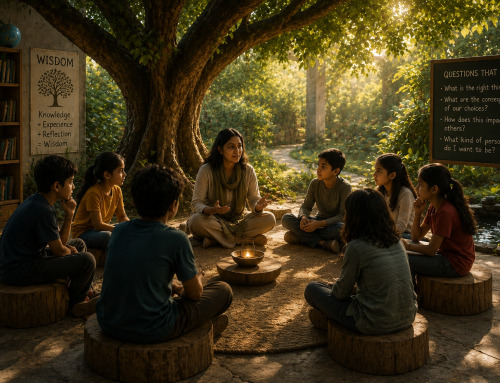
Teachers occupy a central role in bridging the gap between schooling and education. They do far more than deliver curriculum. They inspire curiosity, model integrity, encourage thoughtful dialogue, and help students connect knowledge with experience. The influence of an exceptional teacher is often remembered not because of the information taught, but because of the confidence, perspective, and lifelong love of learning they helped cultivate.
Educational leadership is equally significant. School leaders shape cultures that communicate what truly matters. When policies focus exclusively on compliance, efficiency, and measurable outcomes, schooling can become transactional. When leaders also value reflection, relationships, inclusion, intellectual curiosity, and ethical responsibility, schools become environments where education extends beyond academic achievement to human development.
Perhaps the most important measure of an educational institution is not simply how much knowledge students acquire during their years of schooling, but whether they leave with the capacity and desire to continue learning long after formal education has ended. Schools achieve their highest purpose when they prepare individuals not merely to succeed within existing systems, but to contribute thoughtfully, responsibly, and compassionately to the world they will help shape.
Cafe Learning Reflection
Perhaps one of the greatest misconceptions in education is the belief that schooling and education are synonymous. They are not. Schools provide the structures through which learning is organised, but education is ultimately measured by something far less tangible and far more enduring: the kind of person a learner becomes.
A society may succeed in building excellent schools, designing rigorous curricula, and achieving impressive examination results, yet still fall short if education is reduced to the efficient transmission of information. Knowledge undoubtedly matters, but its highest purpose is not accumulation—it is transformation. Education should enable individuals to think independently, act ethically, appreciate different perspectives, and continue learning with curiosity and humility throughout their lives.
In an age where artificial intelligence can increasingly store, retrieve, and generate knowledge, the distinction between schooling and education becomes even more significant. The true value of education will not lie in what students can remember, but in how they use what they know to make wise decisions, strengthen communities, and improve the world around them.
Perhaps the ultimate measure of education is not whether students leave school with excellent qualifications, but whether they leave with the wisdom to use those qualifications in the service of humanity. Schooling may prepare individuals for examinations, careers, and professions. Education prepares them for life.
Selected References
Biesta, G. (2020). Educational Research: An Unorthodox Introduction. Bloomsbury Academic.
Dewey, J. (1916). Democracy and Education. Macmillan.
Freire, P. (1970). Pedagogy of the Oppressed. Continuum.
Noddings, N. (2013). Education and Democracy in the 21st Century. Teachers College Press.
OECD. (2019). OECD Learning Compass 2030: A Series of Concept Notes. OECD Publishing.
Schleicher, A. (2018). World Class: How to Build a 21st-Century School System. OECD Publishing.
UNESCO. (2021). Reimagining Our Futures Together: A New Social Contract for Education. UNESCO Publishing.
UNESCO. (2023). Guidance for Generative AI in Education and Research. UNESCO Publishing.
Whitehead, A. N. (1929). The Aims of Education and Other Essays. Macmillan.
Zhao, Y. (2012). World Class Learners: Educating Creative and Entrepreneurial Students. Corwin.