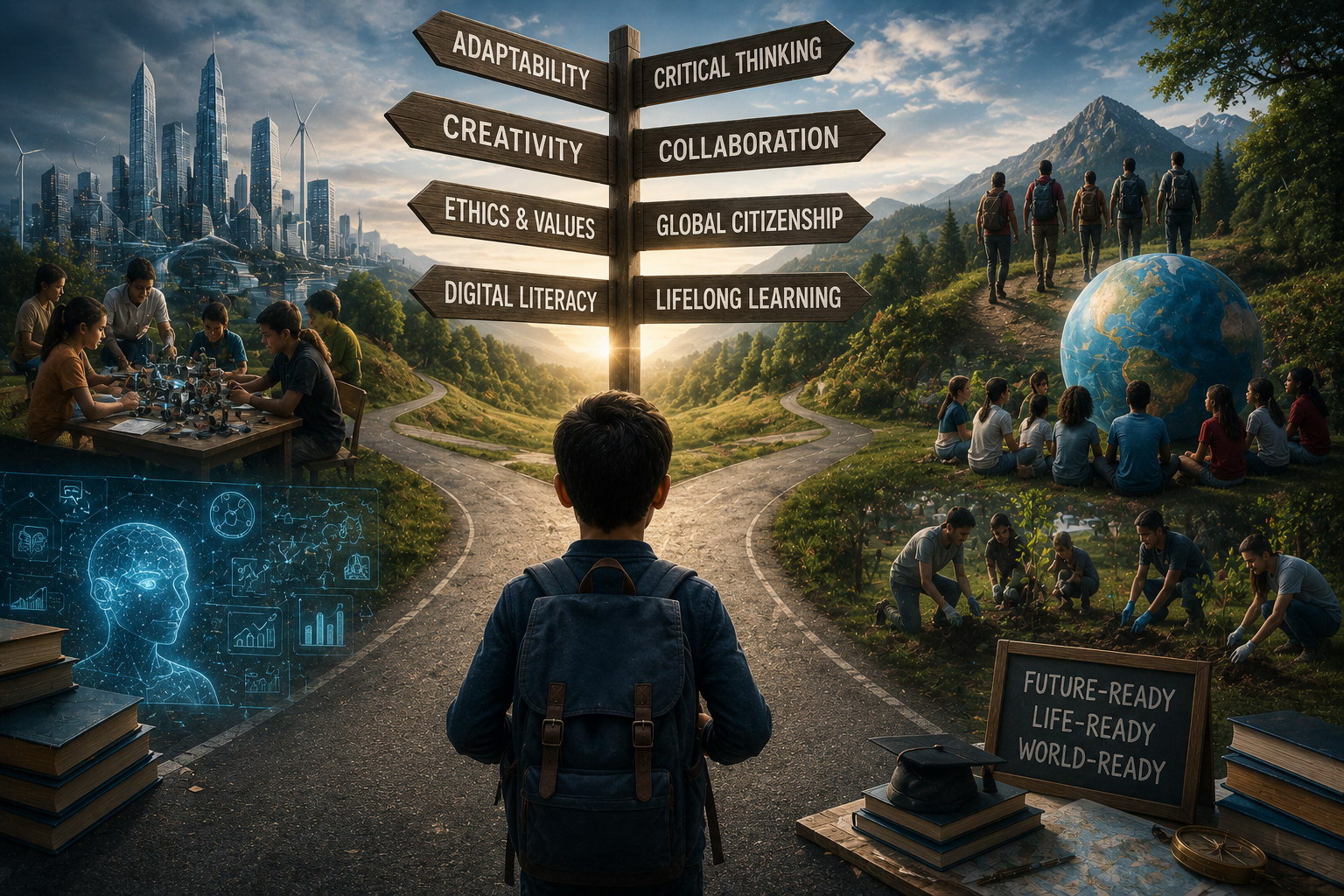
What Should Schools Actually Prepare Students For?
Why the Purpose of Education Must Be Reimagined in an Age of Artificial Intelligence, Climate Change, and Global Uncertainty
Introduction
For more than a century, schools around the world have largely pursued the same fundamental mission: preparing young people for the future. Yet there is an important question that education has too rarely paused to examine. What future are we preparing them for?
The world that shaped modern education no longer exists. The systems that educated previous generations were designed during periods when industrialisation, standardised production, and relatively predictable career pathways defined economic and social life. Success depended largely upon mastering established knowledge, following structured procedures, and applying specialised skills within stable professions. Schools responded by building curricula that emphasised content mastery, efficiency, standardisation, and measurable achievement.
The twenty-first century presents a profoundly different reality. Artificial intelligence is reshaping the nature of work and knowledge. Climate change is demanding unprecedented global cooperation and long-term thinking. Democratic societies are grappling with misinformation, political polarisation, and declining public trust. Rapid technological innovation continues to transform industries faster than education systems can redesign curricula. Many of today’s students will enter careers that have not yet been created while confronting challenges that cannot be solved through memorisation alone.
These transformations raise an uncomfortable but necessary question. If the world has fundamentally changed, has the purpose of schooling changed with it? Or are many education systems still preparing learners for conditions that belong increasingly to the past?
This is not an argument that schools should abandon literacy, mathematics, science, or disciplinary knowledge. Foundational knowledge remains essential because meaningful thinking depends upon a strong base of understanding. Rather, the challenge is whether knowledge alone is sufficient. In a world where information is instantly accessible and increasingly generated by intelligent technologies, education must also cultivate the judgement to evaluate information, the curiosity to pursue meaningful questions, the adaptability to navigate uncertainty, and the ethical responsibility to use knowledge wisely.
Perhaps the most important educational debate of our time is therefore not about artificial intelligence, assessment, curriculum reform, or digital technology in isolation. It is about purpose. Until schools reach greater clarity about what they are ultimately trying to develop in young people, discussions about how education should change will remain incomplete.
The future of education begins with a deceptively simple question: What kind of human beings should schools help students become?
The Original Purpose of Schooling: Preparing Students for a Different World
Education has never existed in isolation from society. Throughout history, schools have reflected the economic, political, and cultural priorities of the communities they serve. The purpose of schooling has continually evolved alongside changes in human civilisation, responding to new forms of work, citizenship, and knowledge. Understanding this historical relationship is essential because it reminds us that educational systems are not fixed institutions; they are social designs created to meet the needs of a particular era.
The modern school system emerged during a period of rapid industrialisation and nation-building. Expanding economies required literate and numerate workers capable of operating within increasingly complex organisations, while governments sought to educate citizens who shared common languages, civic values, and national identities. Schools therefore became institutions that provided foundational knowledge, developed essential workplace skills, and established common expectations for participation in society. Standardised curricula, age-based classrooms, fixed timetables, and formal assessment systems reflected the organisational needs of that historical context.
These priorities were not misguided. On the contrary, they contributed significantly to economic development, scientific advancement, social mobility, and the expansion of educational opportunity. Millions of learners acquired literacy, mathematical reasoning, and disciplinary knowledge that transformed both individual lives and national prosperity. Modern education has been one of humanity’s most important achievements, enabling societies to expand knowledge, reduce inequality, and improve quality of life across generations.
Yet educational systems inevitably inherit the assumptions of the eras in which they were created. Many schools continue to prioritise curriculum coverage, content acquisition, and examination performance because these measures have long been associated with educational success. While these objectives remain valuable, they reflect a period when information was comparatively scarce, professional pathways were more predictable, and knowledge changed at a slower pace than it does today.
The contemporary world presents a markedly different landscape. Information is no longer difficult to obtain. Artificial intelligence can retrieve, organise, and generate knowledge within seconds. Careers evolve rapidly, interdisciplinary collaboration has become commonplace, and global challenges increasingly demand creativity, ethical reasoning, adaptability, and lifelong learning. These changes do not render traditional educational goals obsolete, but they do invite an important question: Are schools still organised primarily around the needs of the past, or are they intentionally preparing students for the realities of the future?
Answering that question requires more than updating curricula or introducing new technologies. It requires re-examining the very purpose of education itself. Before schools decide what students should learn, they must first decide what kind of world learners are being prepared to enter—and what kind of human beings they will need to become in order to thrive within it.
Why the Traditional Purpose of Schooling Is No Longer Enough
The enduring success of modern education should not prevent us from recognising that the context in which schools now operate has fundamentally changed. The knowledge, skills, and structures that served previous generations remain valuable, but they are no longer sufficient on their own. Preparing students for the future now requires more than transmitting established knowledge; it requires equipping learners to navigate a world characterised by complexity, uncertainty, and continuous change.
One of the defining characteristics of the twenty-first century is the accelerating pace of transformation. Scientific discoveries, technological innovation, global migration, environmental challenges, and economic disruption are reshaping societies at a speed rarely witnessed in human history. Entire industries emerge and evolve within a single decade, while occupations that were once considered stable are being redefined by automation and artificial intelligence. In such an environment, the ability to adapt becomes as important as the ability to remember.
Artificial intelligence illustrates this shift particularly clearly. For generations, educational success was closely linked to acquiring information because access to knowledge was limited. Today, intelligent technologies can retrieve facts, generate explanations, translate languages, analyse data, and even produce sophisticated written content within seconds. This does not diminish the importance of knowledge; rather, it changes its educational significance. When information becomes increasingly accessible, the distinguishing capabilities of human learners lie less in recalling facts and more in interpreting evidence, exercising judgement, asking meaningful questions, solving unfamiliar problems, and making ethical decisions.
At the same time, societies face challenges that cannot be addressed through disciplinary expertise alone. Climate change, public health crises, misinformation, social inequality, geopolitical instability, and rapid technological change all require citizens who can think critically, collaborate across cultures, evaluate competing perspectives, and balance innovation with ethical responsibility. These are not simply workplace competencies; they are civic capabilities essential for sustaining democratic societies and addressing complex global problems.
This changing landscape also challenges traditional assumptions about educational success. High examination scores, while valuable indicators of academic achievement, cannot fully capture whether students are prepared to learn continuously, adapt confidently, or contribute responsibly in an unpredictable world. Educational excellence must therefore be understood more broadly—not as the accumulation of knowledge alone, but as the development of intellectual, ethical, and social capacities that enable individuals to continue learning throughout their lives.
The purpose of schooling, then, is expanding rather than disappearing. Foundational knowledge remains indispensable because meaningful thinking requires something to think with. However, knowledge must increasingly serve as the foundation upon which learners develop judgement, adaptability, curiosity, creativity, empathy, and ethical reasoning. These capacities enable students not merely to respond to change but to participate thoughtfully in shaping it.
The central question facing education is therefore no longer whether schools should prepare students for the future. They always have. The question is whether our current definition of preparation reflects the realities of the future students will actually inherit. Answering that question may prove to be one of the most important educational responsibilities of our generation.
Beyond Knowledge: What Students Actually Need to Thrive
If the purpose of education is evolving, then schools must also reconsider what it truly means to prepare students for the future. This does not imply abandoning academic excellence or reducing the importance of disciplinary knowledge. On the contrary, knowledge remains the indispensable foundation of education. The challenge is that knowledge alone is no longer enough. The future demands individuals who can apply what they know wisely, adapt what they know responsibly, and continue expanding what they know throughout their lives.
Perhaps the most important outcome of education is not the accumulation of information but the development of judgement. In an age where artificial intelligence can generate answers within seconds and digital platforms provide an endless stream of information, students must learn to distinguish evidence from opinion, credibility from misinformation, and complexity from oversimplification. Judgement enables learners to make thoughtful decisions in situations where there are no predetermined answers, no standard procedures, and no algorithm capable of resolving every ethical dilemma.
Adaptability has become equally essential. Previous generations often prepared for careers that remained relatively stable over decades. Today’s learners are far more likely to experience multiple professions, rapidly changing technologies, and evolving social expectations throughout their lives. Preparing students for this reality requires more than teaching them specific content; it requires cultivating intellectual flexibility, resilience, and the confidence to continue learning long after formal schooling has ended. Education should prepare learners not merely for their first career, but for a lifetime of change.
Equally significant is the development of ethical responsibility. Technological advancement has expanded human capability at an extraordinary pace, but capability without wisdom can produce unintended consequences. Whether students are designing artificial intelligence systems, conducting scientific research, leading organisations, or participating in democratic societies, they will face decisions that require empathy, integrity, and moral reasoning. Schools therefore have a responsibility not only to develop capable individuals but also to nurture responsible citizens who recognise that knowledge carries ethical obligations.
Human relationships remain another essential dimension of future readiness. Despite unprecedented technological progress, the challenges facing societies increasingly require collaboration across cultures, disciplines, and perspectives. Learners must develop the capacity to communicate respectfully, appreciate diversity, resolve disagreement constructively, and work collectively toward shared goals. These abilities cannot be cultivated through isolated academic achievement alone; they emerge through educational experiences that value dialogue, cooperation, and mutual understanding.
Finally, education must preserve the qualities that enable lifelong learning itself. Curiosity encourages learners to continue asking meaningful questions. Deep reading develops the patience to engage thoughtfully with complex ideas. Sustained attention allows understanding to deepen beyond surface-level information. Reflection transforms experience into wisdom. Together, these human capacities create learners who are not simply prepared for the future but prepared to continue learning throughout it.
Perhaps this represents the most significant shift in educational thinking. The purpose of schooling is no longer simply to prepare students to participate in society as it exists today. It is to prepare them to improve the society they will inherit tomorrow. That requires more than knowledgeable graduates. It requires thoughtful, adaptable, ethical, and compassionate human beings capable of shaping a future that none of us can fully predict.
Reimagining Schools as Places of Human Development
If the purpose of education is broader than preparing students to pass examinations or enter the workforce, then schools themselves must be understood differently. They are not simply institutions for delivering curriculum or transmitting knowledge. At their best, they are communities in which young people develop intellectually, ethically, socially, and emotionally. Education is not only about preparing students for employment; it is about preparing them for life.
This broader understanding requires a shift in educational priorities. Curriculum should continue to provide rigorous disciplinary knowledge, but it should also create opportunities for students to grapple with authentic problems, consider diverse perspectives, and apply learning in meaningful contexts. Assessment should continue to measure academic achievement while also recognising growth in reasoning, collaboration, creativity, and ethical decision-making. Technology should enhance learning without replacing the human relationships and reflective experiences through which lasting understanding develops.
Teachers occupy a uniquely significant position within this vision. Their role extends far beyond delivering content. They cultivate curiosity, encourage thoughtful dialogue, challenge assumptions, and help students develop confidence in their own capacity to think independently. In an age where information is increasingly accessible through artificial intelligence, the teacher’s greatest contribution lies not in possessing every answer but in helping learners ask better questions, interpret knowledge critically, and connect learning to the realities of human experience.
Educational leaders carry an equally important responsibility. Every decision regarding curriculum, assessment, professional learning, technology, and school culture communicates a particular understanding of what education values. Leadership therefore involves more than improving organisational performance; it involves protecting the broader purpose of education itself. Schools flourish when leaders create environments where academic excellence is pursued alongside intellectual curiosity, ethical responsibility, inclusion, and human wellbeing.
This vision also calls for renewed partnerships between schools, families, and communities. Preparing students for an uncertain future cannot be achieved through schools working in isolation. Young people develop their values, identities, and aspirations through the combined influence of families, educators, peers, and society. Education therefore becomes a shared responsibility—one that extends beyond classrooms to the wider communities in which learners live and grow.
Ultimately, reimagining schools is not about abandoning tradition but about reaffirming education’s deepest purpose. Throughout history, societies have looked to schools to prepare each new generation for the future. That responsibility remains unchanged. What has changed is our understanding of what genuine preparation requires. In the decades ahead, the most successful schools will not simply produce knowledgeable graduates. They will cultivate thoughtful individuals who possess the wisdom to navigate complexity, the courage to question assumptions, the compassion to work with others, and the imagination to build a better future than the one they inherited.
Cafe Learning Reflection
Every generation inherits schools from the past while preparing children for a future that cannot yet be fully imagined. This has always been education’s greatest paradox. Schools must preserve humanity’s accumulated knowledge while simultaneously preparing learners for challenges that have no established answers. The tension between continuity and change is therefore not a problem to be solved; it is the enduring responsibility of education itself.
Perhaps this is why the purpose of schooling deserves continual reconsideration. Educational debates often focus on curriculum reforms, assessment policies, technological innovation, or classroom practice. These conversations are undoubtedly important, but they all rest upon a more fundamental question: What kind of people do we hope our education systems will help create? Until that question is answered with clarity, every discussion about educational improvement risks addressing symptoms rather than purpose.
The future will almost certainly demand knowledge that has not yet been discovered, technologies that have not yet been invented, and professions that have not yet been imagined. Yet the human qualities required to navigate such uncertainty are already becoming clear. The capacity to think critically, act ethically, learn continuously, collaborate across differences, and exercise thoughtful judgement will remain valuable regardless of how rapidly the world changes. These are not merely educational outcomes; they are the foundations of responsible citizenship and human flourishing.
Perhaps, then, the greatest legacy of a school is not measured by the examination results of the students who leave its classrooms, but by the character, wisdom, and sense of responsibility they carry into the world beyond them. When education succeeds in developing knowledgeable minds alongside compassionate hearts and ethical judgement, it accomplishes something that extends far beyond academic achievement. It helps shape not only the future of individual learners, but the future of society itself.
Selected References
Biesta, G. (2020). Educational Research: An Unorthodox Introduction. Bloomsbury Academic.
Dewey, J. (1916). Democracy and Education. Macmillan.
Freire, P. (1970). Pedagogy of the Oppressed. Continuum.
Fullan, M. (2020). Leading in a Culture of Change (2nd ed.). Jossey-Bass.
OECD. (2019). OECD Learning Compass 2030: A Series of Concept Notes. OECD Publishing.
Schleicher, A. (2018). World Class: How to Build a 21st-Century School System. OECD Publishing.
UNESCO. (2021). Reimagining Our Futures Together: A New Social Contract for Education. UNESCO Publishing.
UNESCO. (2023). Guidance for Generative AI in Education and Research. UNESCO Publishing.
World Economic Forum. (2023). The Future of Jobs Report 2023. World Economic Forum.
Zhao, Y. (2012). World Class Learners: Educating Creative and Entrepreneurial Students. Corwin.