
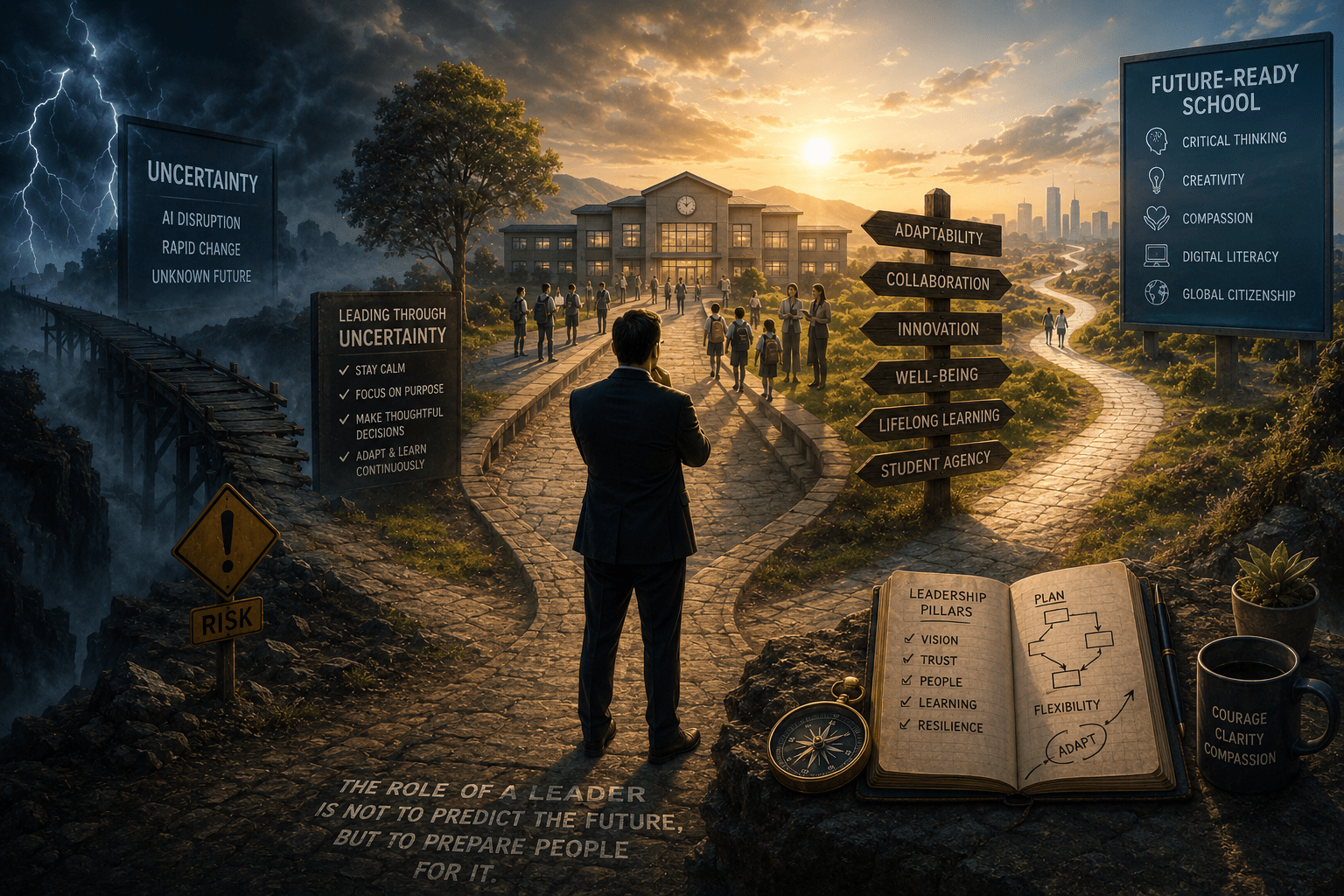
Leading Schools Through Uncertainty
Educational Leadership in the Age of Artificial Intelligence and Continuous Change
Introduction
Educational leadership has always involved navigating change. New curricula are introduced, assessment policies evolve, technologies emerge, and societal expectations shift. Throughout much of modern educational history, however, these changes occurred within a relatively stable landscape. Leaders could anticipate future needs with reasonable confidence, develop long-term strategic plans, and guide their schools toward clearly defined objectives.
Today’s reality is fundamentally different.
Artificial intelligence is reshaping how knowledge is created and accessed. Labour markets are evolving at unprecedented speed. Student wellbeing challenges are becoming increasingly complex. Expectations surrounding digital citizenship, sustainability, inclusion, and lifelong learning continue to expand. At the same time, schools are expected to improve academic outcomes while preparing learners for professions, technologies, and societal conditions that may not yet exist.
The defining challenge for educational leaders is therefore no longer change itself. Change has always been part of leadership. The greater challenge is leading when certainty has disappeared.
This distinction matters because uncertainty demands a different kind of leadership. Traditional models often assume that leaders possess clear answers, predictable plans, and complete information before making decisions. Contemporary school leadership requires something different: the capacity to make thoughtful decisions amid ambiguity, adapt continuously as new evidence emerges, and inspire confidence even when the future cannot be fully predicted.
Paradoxically, uncertainty should not be viewed solely as a threat. It also creates opportunities for innovation, collaboration, organisational learning, and educational transformation. Schools that develop adaptive cultures are often better positioned to respond to emerging challenges than those seeking to preserve familiar practices simply because they have worked in the past.
Perhaps the question educational leaders should ask is no longer, “How do we prepare for the future?” A more appropriate question may be, “How do we build schools capable of thriving regardless of what the future brings?”
Change Can Be Managed. Uncertainty Must Be Led.
Educational leaders have long been encouraged to become effective managers of change. Leadership programmes, strategic planning frameworks, and school improvement models often assume that successful change begins with a clearly defined destination, followed by a carefully sequenced implementation plan. This approach remains valuable when objectives are well understood and the path forward is reasonably predictable.
Uncertainty presents an entirely different leadership challenge.
Unlike planned change, uncertainty offers no detailed roadmap. Leaders must make important decisions despite incomplete information, emerging evidence, and rapidly evolving circumstances. They cannot postpone every decision until perfect clarity arrives because schools continue to operate, teachers continue to teach, and students continue to learn regardless of whether the future feels predictable. Leadership therefore becomes less about possessing all the answers and more about developing the confidence to make thoughtful decisions while remaining willing to adapt as new realities emerge.
This distinction has become increasingly relevant in education. Artificial intelligence is transforming teaching and learning at a pace few anticipated. New technologies appear before schools have fully integrated existing ones. The future skills employers value continue to evolve, while student wellbeing, digital citizenship, sustainability, and global interconnectedness introduce challenges that rarely have straightforward solutions. Educational leaders are no longer preparing schools for a single foreseeable future; they are preparing them for multiple possible futures.
In such an environment, certainty can become an illusion. Leaders who wait for complete information before acting often find themselves responding too slowly, while those who cling rigidly to long-term plans may struggle to recognise when circumstances demand a different course of action. Adaptive leadership does not reject planning; it recognises that plans must remain sufficiently flexible to accommodate new knowledge, unexpected challenges, and emerging opportunities.
Perhaps the most significant shift required is psychological rather than procedural. Instead of asking, “How can I eliminate uncertainty?” educational leaders might ask, “How can I help my school become more capable of learning, adapting, and thriving despite uncertainty?” The latter question acknowledges an important reality: uncertainty is unlikely to disappear. The competitive advantage of tomorrow’s schools will therefore lie not in predicting the future with perfect accuracy, but in developing the organisational capacity to respond wisely when the future unfolds differently than expected.
What Adaptive Leaders Do Differently
Adaptive leaders do not attempt to predict every challenge the future may bring. Instead, they develop schools that possess the collective capacity to respond intelligently when unexpected challenges arise. Their confidence comes not from believing they can foresee every outcome, but from knowing their organisation can learn, adjust, and improve regardless of changing circumstances.
One of their defining characteristics is intellectual humility. Adaptive leaders recognise that no individual possesses all the answers, particularly in an era where technological, social, and educational developments evolve at extraordinary speed. Rather than projecting certainty where none exists, they create cultures in which questioning, experimentation, and evidence-informed decision-making are viewed as professional strengths rather than signs of uncertainty. They understand that leadership credibility is enhanced not by always being right, but by being willing to learn.
These leaders also distribute expertise rather than centralise authority. They acknowledge that the most valuable insights often emerge from classrooms, collaborative teams, and professional learning communities rather than exclusively from senior leadership offices. Teachers, instructional coaches, department heads, students, and even parents contribute perspectives that help organisations recognise emerging challenges and identify innovative solutions. Adaptive leadership therefore depends upon collective intelligence as much as individual capability.
Equally important is their commitment to organisational learning. Instead of asking whether an initiative succeeded or failed, adaptive leaders ask what the organisation learned through the process. They encourage structured reflection following curriculum implementation, professional development, technology integration, and school improvement initiatives. Success becomes not merely the achievement of predetermined goals, but the continuous strengthening of the school’s capacity to learn from experience.
Perhaps the most distinguishing characteristic of adaptive leaders is their ability to provide stability without creating rigidity. During periods of uncertainty, teachers and students do not necessarily expect leaders to possess perfect answers. They seek confidence, consistency, transparency, and a clear sense of purpose. Adaptive leaders provide this reassurance by remaining anchored in enduring educational values while remaining flexible in the strategies used to achieve them. They preserve the school’s mission while allowing its methods to evolve.
Ultimately, adaptive leadership shifts the central question from “How do we avoid uncertainty?” to “How do we build a school that becomes stronger because it learns from uncertainty?” This perspective transforms uncertainty from an obstacle to organisational growth into a catalyst for innovation, resilience, and continuous improvement.
From Insight to Action
Leading through uncertainty does not require leaders to predict the future with perfect accuracy. It requires them to develop schools that can learn, adapt, and respond intelligently as circumstances evolve. The following practices can help educational leaders strengthen their school’s adaptive capacity while maintaining clarity, confidence, and purpose.
1. Build Planning Cycles Around Learning, Not Certainty
Traditional strategic plans often assume that priorities will remain relatively stable over several years. In rapidly changing educational environments, leaders should regularly revisit assumptions, evaluate emerging evidence, and refine priorities as new information becomes available. Treat strategic planning as an iterative process rather than a fixed destination.
2. Create Safe Spaces for Professional Experimentation
Innovation flourishes where teachers feel trusted to test new approaches without fear of blame if outcomes are imperfect. Encourage pilot projects, lesson studies, action research, and collaborative inquiry. Celebrate thoughtful experimentation and the learning it generates, not only successful outcomes. Schools that learn quickly are better equipped to respond to uncertainty than schools that simply avoid risk.
3. Strengthen Collective Intelligence
No leader can anticipate every challenge alone. Develop leadership capacity throughout the organisation by involving teachers, department heads, instructional coaches, and students in meaningful decision-making. Diverse perspectives improve the quality of decisions while fostering shared ownership of school improvement. The future belongs to schools where leadership is distributed rather than concentrated.
4. Anchor Change in Enduring Values
While technologies, policies, and educational priorities will continue to evolve, a school’s core values should remain a stable reference point. When difficult decisions arise, return to fundamental questions: Does this improve learning? Does it strengthen equity? Does it support wellbeing? Does it align with our educational purpose? Values provide continuity when external conditions remain uncertain.
5. Develop a Culture That Learns Faster Than the Environment Changes
The most resilient schools are not necessarily those with the best forecasts; they are those with the strongest learning cultures. Encourage regular reflection, analyse both successes and setbacks, seek feedback from staff and students, and use evidence to refine practice continuously. When organisational learning becomes routine, uncertainty is transformed from a source of disruption into a source of improvement.
Leadership Challenge for This Week
Review one major initiative currently underway in your school and ask your leadership team the following questions:
- Which assumptions are we making that may no longer be valid?
- What new information have we learned since this initiative began?
- If we were designing this initiative today, what would we do differently?
- What is one adjustment we can make this month to strengthen its impact?
Adaptive leadership begins when leaders view reflection as an ongoing discipline rather than an occasional activity.
Cafe Learning Reflection
For much of educational history, leadership has been associated with certainty. Leaders were expected to possess answers, define clear directions, and provide confidence through predictability. Today’s educational landscape requires a different understanding of leadership.
The future is unlikely to become more stable, more predictable, or less complex. Artificial intelligence will continue to reshape learning, new societal challenges will emerge, and educational priorities will inevitably evolve. Waiting for complete certainty before making decisions is no longer a realistic option. Instead, effective leadership depends on the capacity to learn continuously, adapt thoughtfully, and lead with purpose even when every answer is not yet known.
This shift should not diminish leaders’ confidence; it should redefine it. The strongest educational leaders are not those who claim to predict the future with precision, but those who cultivate schools capable of responding intelligently to whatever the future brings. Their confidence rests not in certainty, but in the collective strength, professionalism, and adaptability of the people they lead.
Ultimately, uncertainty is not the opposite of effective leadership. It is the environment in which modern educational leadership is exercised. Schools that embrace continuous learning, encourage thoughtful innovation, and remain anchored in enduring values will not merely survive an unpredictable future—they will help shape it.
Selected References
Fullan, M. (2020). Leading in a Culture of Change (2nd ed.). Jossey-Bass.
Heifetz, R. A., Grashow, A., & Linsky, M. (2009). The Practice of Adaptive Leadership. Harvard Business Press.
Hargreaves, A., & Shirley, D. (2020). Leading from the Middle: Spreading Learning, Well-Being, and Identity Across Ontario. Corwin.
Kotter, J. P. (2012). Leading Change. Harvard Business Review Press.
OECD. (2020). Back to the Future of Education: Four OECD Scenarios for Schooling. OECD Publishing.
Robinson, V. M. J. (2011). Student-Centered Leadership. Jossey-Bass.
Schein, E. H., & Schein, P. A. (2021). Organizational Culture and Leadership (6th ed.). Wiley.
UNESCO. (2021). Reimagining Our Futures Together: A New Social Contract for Education. UNESCO Publishing.
UNESCO. (2023). Guidance for Generative AI in Education and Research. UNESCO Publishing.
World Economic Forum. (2025). The Future of Jobs Report. World Economic Forum.