Can Schools Teach Wisdom?
Why Education Must Aim Beyond Knowledge in an Age of Artificial Intelligence
Introduction
Every day, millions of students solve mathematical equations, analyse literature, conduct scientific investigations, and memorise historical events. Yet very few schools explicitly teach one of the most important human capacities of all: wisdom.
This distinction matters because knowledge and wisdom are fundamentally different. Knowledge enables individuals to understand the world; wisdom enables them to navigate it responsibly. Knowledge answers the question, “What do I know?” Wisdom asks, “What should I do with what I know?” While knowledge can be measured through examinations and qualifications, wisdom is revealed through judgement, ethical reasoning, discernment, and the ability to make thoughtful decisions in situations where there are no simple answers.
The emergence of artificial intelligence has made this distinction more significant than ever before. Information can now be retrieved, summarised, translated, and even generated within seconds. As access to knowledge becomes increasingly effortless, the true value of education can no longer lie solely in helping students acquire information. It must also help them evaluate evidence critically, consider multiple perspectives, anticipate consequences, and use knowledge with integrity and compassion.
Many of the defining challenges of the twenty-first century—including artificial intelligence, climate change, misinformation, public health, and global conflict—cannot be addressed through technical expertise alone. They require individuals who combine knowledge with sound judgement, innovation with responsibility, and confidence with intellectual humility. These are qualities more closely associated with wisdom than with information.
This raises a profound educational question. If schools are preparing young people for a future defined by uncertainty rather than certainty, should they focus only on teaching knowledge, or should they also cultivate the wisdom needed to apply that knowledge responsibly? The answer may shape not only the future of education, but the future of society itself.
Why Wisdom Matters More Than Ever
There was a time when knowledge itself represented a significant advantage. Access to reliable information was limited, specialised expertise was relatively scarce, and education was largely concerned with helping learners acquire and retain what they needed to know. Today, that educational landscape has changed fundamentally. Information is abundant, constantly updated, and available within seconds. Artificial intelligence can now retrieve facts, generate explanations, summarise research, and produce sophisticated content with remarkable speed. In this new reality, the competitive advantage is no longer knowledge alone—it is the capacity to use knowledge wisely.
This shift has profound implications for education. Schools have traditionally excelled at helping students answer questions with increasing accuracy. Yet many of the challenges learners will face beyond the classroom have no single correct answer. Ethical dilemmas, environmental sustainability, artificial intelligence, public policy, healthcare, and global citizenship all require individuals to evaluate evidence, balance competing interests, anticipate unintended consequences, and make thoughtful decisions in situations characterised by uncertainty. These are not merely academic tasks; they are exercises in judgement.
Wisdom therefore occupies a distinctive place within education. Unlike knowledge, which can often be accumulated, wisdom develops through reflection, experience, intellectual humility, and the willingness to recognise that complex problems rarely yield simple solutions. A knowledgeable individual may understand multiple perspectives. A wise individual knows when, why, and how those perspectives should inform responsible action. Wisdom transforms information into insight and expertise into sound judgement.
This distinction becomes increasingly important as artificial intelligence assumes responsibility for many routine cognitive tasks. If machines can process information faster than humans, then the enduring value of education lies in cultivating capacities that remain fundamentally human. Empathy, ethical reasoning, discernment, practical judgement, and moral responsibility cannot simply be automated. They emerge through dialogue, reflection, lived experience, and meaningful engagement with others. These qualities enable learners not only to solve problems, but also to ask whether a particular solution is just, responsible, and beneficial for society.
Perhaps the future of education will therefore be defined less by how effectively schools transmit knowledge and more by how intentionally they cultivate wisdom. In an age where answers are increasingly available on demand, the greatest educational challenge may not be helping students know more, but helping them think more deeply, decide more responsibly, and act more wisely.
Can Wisdom Be Taught?
The question itself is deceptively simple. Schools routinely teach mathematics, languages, science, history, and countless other disciplines through carefully designed curricula and structured instruction. Wisdom, however, does not fit neatly within a textbook chapter or a standardised assessment. It cannot be memorised, downloaded, or mastered through repetition alone. Does that mean it lies beyond the reach of education? Not necessarily.
Perhaps the more appropriate question is not whether schools can teach wisdom, but whether they can cultivate it. Wisdom is less an academic subject than a way of thinking and engaging with the world. It develops gradually as learners encounter complexity, reflect on experience, evaluate competing perspectives, and consider the ethical implications of their decisions. While schools cannot guarantee that every student will become wise, they can create educational environments that make wisdom more likely to emerge.
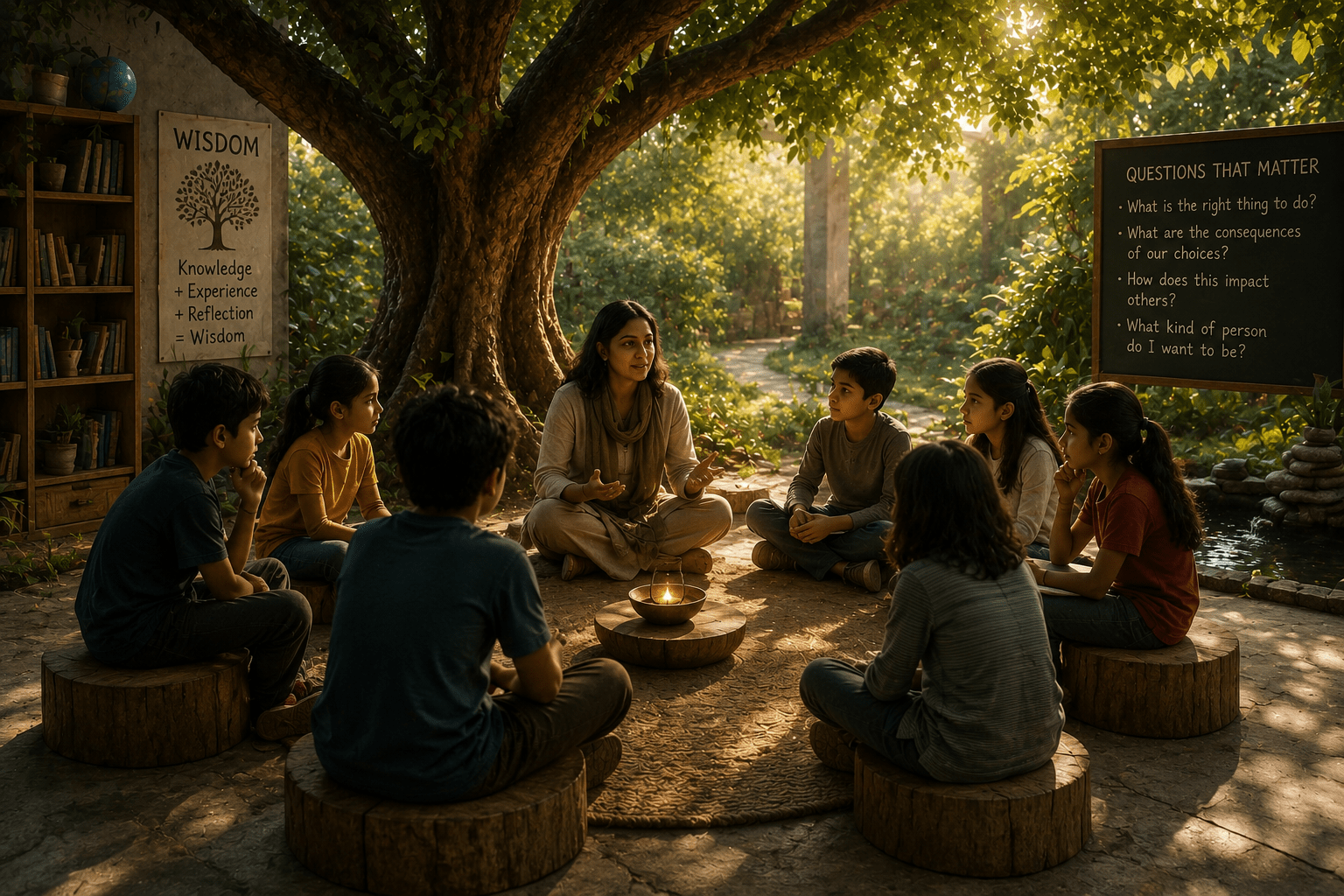
This begins with the kinds of questions students are invited to explore. Classrooms that value inquiry over memorisation, dialogue over recitation, and thoughtful debate over unquestioned agreement encourage learners to grapple with ambiguity rather than avoid it. Instead of asking only, “What is the correct answer?” educators can also ask, “What makes this decision difficult?”, “Whose perspectives are missing?”, or “What might be the long-term consequences?” Such questions move learning beyond information recall and into the realm of judgement and ethical reasoning.
Equally important is the cultivation of intellectual humility. Wisdom is characterised not by certainty but by the recognition that even well-informed people can hold incomplete or imperfect understandings. In an educational culture that often rewards having the right answer, schools should also celebrate curiosity, careful listening, openness to evidence, and the willingness to revise one’s thinking in light of new understanding. These habits strengthen critical thinking while nurturing the reflective mindset that wisdom requires.
The role of teachers is especially significant in this process. Beyond transmitting knowledge, exceptional educators model the very qualities they hope to develop in their students. They demonstrate respect for different viewpoints, acknowledge uncertainty when appropriate, encourage reasoned disagreement, and show that thoughtful decision-making often involves balancing evidence with empathy. In doing so, they teach wisdom not only through what they say, but through how they think, question, and lead.
Ultimately, wisdom cannot be delivered as a lesson or measured through a single examination. It is cultivated through educational experiences that encourage reflection, ethical decision-making, critical inquiry, and meaningful engagement with real-world challenges. Schools may not be able to teach wisdom directly, but they can undoubtedly create the conditions in which it has the opportunity to grow.
Reimagining Schools as Communities of Wisdom
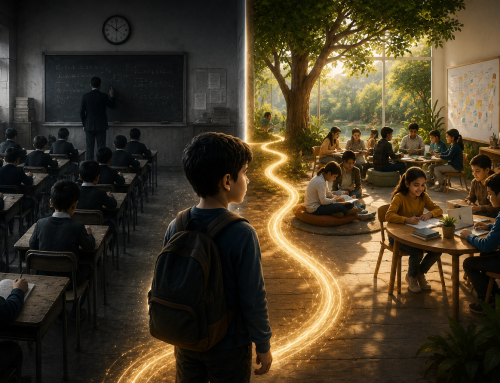
If education is ultimately concerned with preparing young people for life rather than merely preparing them for examinations, then schools must aspire to become more than centres of academic instruction. They must become communities in which knowledge is continually connected with judgement, responsibility, and human flourishing. The question is no longer whether students are learning enough, but whether they are learning to use their knowledge wisely.
A wisdom-centred school does not abandon academic excellence; it redefines its purpose. Academic achievement remains essential because wisdom cannot exist without a strong foundation of knowledge. However, knowledge is treated not as the final destination but as the starting point for deeper reflection, ethical reasoning, and informed action. Students are encouraged not only to master concepts but also to examine their implications, question assumptions, and consider how their learning influences the lives of others.
Such schools deliberately create opportunities for thoughtful dialogue. They invite learners to engage with complex questions that have no single correct answer, explore multiple perspectives with intellectual honesty, and appreciate that disagreement, when approached respectfully, can deepen understanding rather than diminish it. In these environments, curiosity is valued as highly as certainty, and reflection is recognised as an essential component of learning rather than a pause between lessons.
Leadership also plays a decisive role in cultivating wisdom. School leaders influence far more than organisational efficiency; they shape the moral and intellectual culture of their institutions. Every decision about curriculum, assessment, technology, inclusion, and student wellbeing communicates what the school truly values. When leaders consistently prioritise integrity, empathy, critical inquiry, and ethical responsibility alongside academic excellence, they establish a culture in which wisdom becomes an educational aspiration rather than an abstract ideal.
Perhaps this is where the future of education is heading. As artificial intelligence assumes greater responsibility for storing, processing, and generating information, the distinctive contribution of schools will lie less in transmitting knowledge and more in developing the human qualities that technology cannot replicate. The schools that will have the greatest impact in the decades ahead may not simply be those that produce the highest examination results, but those that graduate individuals capable of exercising sound judgement, acting with compassion, and contributing wisely to an increasingly complex world.
Cafe Learning Reflection
Education has always sought to expand human knowledge. Yet knowledge, remarkable as it is, has never been the highest expression of learning. Civilisations have not been transformed simply because people knew more, but because they learned to apply what they knew with wisdom, integrity, and compassion.
Perhaps this is the challenge facing education today. Artificial intelligence can increasingly generate information, analyse data, and solve technical problems with extraordinary speed. What it cannot replace is the distinctly human capacity to exercise judgement, appreciate moral complexity, recognise the consequences of our choices, and act with wisdom in situations where no algorithm can determine the right course of action.
Schools may never be able to teach wisdom as they teach mathematics or science. They can, however, cultivate the habits of mind and character from which wisdom grows: intellectual humility, thoughtful reflection, ethical reasoning, respectful dialogue, curiosity, and the courage to question simple answers to complex problems. These qualities develop gradually through relationships, experience, and educational environments that value understanding as much as achievement.
Perhaps the greatest legacy of education is not that students leave school knowing more than when they arrived, but that they leave prepared to use their knowledge in ways that improve the lives of others. In an age increasingly defined by intelligent machines, the enduring purpose of education may ultimately be to nurture wiser human beings.
Selected References
Ardelt, M. (2004). Wisdom as Expert Knowledge System: A Critical Review of a Contemporary Operationalization of an Ancient Concept. Human Development, 47(5), 257–285.
Biesta, G. (2020). Educational Research: An Unorthodox Introduction. Bloomsbury Academic.
Dewey, J. (1916). Democracy and Education. Macmillan.
Freire, P. (1970). Pedagogy of the Oppressed. Continuum.
Noddings, N. (2013). Education and Democracy in the 21st Century. Teachers College Press.
OECD. (2019). OECD Learning Compass 2030: A Series of Concept Notes. OECD Publishing.
Sternberg, R. J. (2001). Why Schools Should Teach for Wisdom: The Balance Theory of Wisdom in Educational Settings. Educational Psychologist, 36(4), 227–245.
UNESCO. (2021). Reimagining Our Futures Together: A New Social Contract for Education. UNESCO Publishing.
UNESCO. (2023). Guidance for Generative AI in Education and Research. UNESCO Publishing.
Whitehead, A. N. (1929). The Aims of Education and Other Essays. Macmillan.