

Teaching in the Age of Artificial Intelligence: Why Human Teachers Matter More Than Ever
Rethinking the Teacher’s Role in an Era of Intelligent Machines
Introduction
For the first time in the history of education, students carry in their pockets technologies capable of generating essays, explaining complex scientific concepts, solving mathematical problems, translating multiple languages, creating computer code, producing artwork, and answering questions within seconds. Artificial intelligence has fundamentally altered how knowledge is accessed, created, and shared. Information that once required hours of searching through textbooks, libraries, or online databases can now be generated almost instantly through conversational AI systems.
This technological transformation has prompted one of the most debated questions in contemporary education: Will artificial intelligence replace teachers?
Although understandable, I believe this question is fundamentally misplaced.
Throughout history, educational innovation has repeatedly sparked predictions about the declining importance of teachers. Radio, television, personal computers, the internet, online learning platforms, and massive open online courses (MOOCs) were each described at various moments as technologies that would revolutionise education and significantly reduce the need for classroom teachers. Yet despite profound technological change, the essential human purpose of teaching has endured. What has evolved is not the importance of teachers but the nature of their professional role.
Artificial intelligence represents another transformative moment, but one that differs from previous technological developments in both scale and sophistication. Unlike earlier educational technologies that primarily improved access to information, generative AI can produce explanations, summarise research, generate lesson plans, create assessments, personalise feedback, and support increasingly complex cognitive tasks. Consequently, many of the routine activities traditionally associated with teaching are being redefined. This reality understandably raises important questions for educators, school leaders, and policymakers about the future of professional practice.
Yet education has never been solely about the transmission of information. If the purpose of teaching were simply to deliver knowledge, schools would have become obsolete long before artificial intelligence emerged. Effective teachers do far more than explain content. They cultivate curiosity, interpret individual learning needs, build trusting relationships, exercise professional judgement, nurture ethical understanding, encourage resilience, and create classroom communities where intellectual and personal growth can flourish. These dimensions of teaching remain deeply human because they depend upon empathy, context, experience, and moral responsibility rather than information alone.
International organisations increasingly recognise this distinction. UNESCO has consistently argued that artificial intelligence should strengthen rather than replace human-centred education, emphasising ethical governance, equity, and the protection of meaningful human relationships in learning environments. Similarly, the OECD has highlighted the growing importance of competencies such as critical thinking, creativity, collaboration, learner agency, and ethical decision-making—capabilities that require thoughtful educational guidance rather than technological automation. These perspectives suggest that the future of education depends not upon choosing between teachers and technology, but upon understanding how each can contribute distinct forms of value.
Perhaps, then, the most important question facing educational leaders is not whether artificial intelligence can teach, but rather what aspects of teaching remain uniquely and irreducibly human.
Answering that question requires us to move beyond viewing teachers primarily as providers of information and instead recognise them as designers of learning, interpreters of human development, and architects of educational experiences that no technology, regardless of its sophistication, can fully replicate.
Beyond the False Debate: Artificial Intelligence Does Not Replace the Human Purpose of Teaching
Public discussions about artificial intelligence in education often revolve around a single question: Will AI replace teachers? While understandable, this framing oversimplifies both the nature of artificial intelligence and the complexity of teaching. It assumes that education is primarily an exercise in information delivery and that teaching can therefore be evaluated according to how efficiently knowledge is transmitted. Such assumptions fail to recognise the broader educational purposes that schools have always served.
Teaching has never been defined solely by the communication of information. Long before digital technologies emerged, effective educators understood that learning involves far more than acquiring factual knowledge. Students require guidance in interpreting ideas, evaluating evidence, navigating uncertainty, developing ethical judgement, collaborating with others, and constructing meaning from their experiences. These dimensions of learning are deeply relational and contextual. They depend not only upon cognitive development but also upon trust, empathy, encouragement, and professional judgement—qualities that cannot be reduced to algorithmic processes.
Artificial intelligence undoubtedly excels at tasks involving information processing. It can retrieve knowledge, generate explanations, personalise practice activities, analyse data, summarise complex texts, and provide immediate feedback with remarkable speed. These capabilities make AI an increasingly valuable educational resource. Used thoughtfully, AI can reduce administrative workload, support lesson planning, differentiate learning materials, and expand access to educational opportunities for diverse learners. In many respects, artificial intelligence has the potential to become one of the most significant instructional tools available to educators.
However, educational value should not be confused with educational purpose. A technology’s ability to support learning does not mean it can assume responsibility for the broader developmental mission of teaching. Teachers do not simply respond to correct or incorrect answers; they interpret hesitation, recognise emotional needs, understand cultural contexts, identify misconceptions that extend beyond academic content, and make nuanced decisions based on the unique circumstances of individual learners. Such judgements require contextual understanding that extends beyond pattern recognition or probabilistic prediction.
This distinction becomes even more significant as schools seek to prepare students for a future characterised by continuous technological advancement. Ironically, the more capable artificial intelligence becomes at performing routine cognitive tasks, the more valuable uniquely human capabilities become. Creativity, ethical reasoning, empathy, adaptability, intercultural understanding, collaboration, and professional judgement are increasingly recognised by organisations such as UNESCO, the OECD, and the World Economic Forum as essential competencies for future-ready learners. These are precisely the capacities that flourish through meaningful human relationships and thoughtful educational guidance.
Rather than asking whether teachers and artificial intelligence compete for the same role, educational leaders should recognise that they contribute different forms of value to the learning process. Artificial intelligence extends human capability by increasing access to information and enhancing instructional efficiency. Teachers extend human potential by helping learners develop identity, confidence, wisdom, curiosity, resilience, and purpose. One supports learning; the other gives learning meaning.
Understanding this distinction allows schools to move beyond the false choice between embracing technology and preserving human teaching. The future of education will not be determined by deciding whether teachers or artificial intelligence are more important. Instead, it will depend upon how effectively educational leaders redefine the teacher’s role within learning environments where intelligent technologies are increasingly commonplace.
This shift in perspective raises a more important question than whether AI can perform teaching tasks. It invites us to ask: What forms of human expertise become even more valuable when information itself is no longer scarce? Answering that question requires a deeper understanding of what constitutes the enduring human advantage in education.
The Human Advantage Framework: Redefining the Teacher’s Role in an AI-Enabled World
As artificial intelligence assumes responsibility for an increasing number of routine cognitive tasks, the defining question for education is no longer what AI can do, but what teachers can do that technology cannot. Answering this question requires moving beyond traditional descriptions of teaching and recognising that the profession has always encompassed far more than the transmission of knowledge.
To support this perspective, I propose The Human Advantage Framework—a conceptual model that identifies six uniquely human dimensions of teaching that become increasingly valuable as artificial intelligence becomes more capable. Rather than competing with intelligent technologies, these dimensions represent the enduring strengths that distinguish educators as mentors, leaders, and architects of meaningful learning experiences.
The framework places Meaningful Human Learning at its centre, recognising that education is ultimately concerned with the development of people rather than the delivery of information. Surrounding this central purpose are six interconnected dimensions that define the uniquely human contribution of teachers in the age of artificial intelligence.
The Human Advantage Framework
Meaningful Human Learning
surrounded by:
- Empathy
- Professional Judgment
- Ethical Leadership
- Human Relationships
- Inspiration
- Purpose
Each dimension strengthens the others, creating a learning environment in which technology enhances education without diminishing the central role of human educators.
1. Empathy
Effective teaching begins with understanding learners as individuals rather than simply as performers of academic tasks. Teachers recognise frustration behind silence, confidence behind curiosity, and anxiety behind declining performance. They respond not only to what students produce but also to what they experience. While artificial intelligence can analyse patterns of behaviour, empathy requires emotional understanding, compassion, and authentic human connection.
2. Professional Judgment
Every classroom presents situations that demand thoughtful interpretation rather than predetermined responses. Teachers continuously balance curriculum expectations, learner diversity, cultural context, classroom dynamics, and individual needs when making instructional decisions. Professional judgment draws upon experience, reflection, and ethical reasoning to determine not only what should be taught but how learning should unfold for particular students in particular contexts.
3. Ethical Leadership
Education is fundamentally a moral endeavour. Teachers help students navigate questions of fairness, responsibility, digital citizenship, academic integrity, and respectful participation within democratic societies. As artificial intelligence becomes increasingly influential in education, ethical leadership becomes even more essential. Students require educators who can guide thoughtful conversations about the responsible use of technology while modelling integrity, critical thinking, and ethical decision-making.
4. Human Relationships
Learning flourishes within relationships characterised by trust, belonging, encouragement, and mutual respect. Teachers build classroom communities where students feel psychologically safe to ask questions, take intellectual risks, collaborate with others, and learn from mistakes. Such relationships cannot be generated through algorithms because they depend upon shared experiences, authentic presence, and reciprocal human interaction.
5. Inspiration
Great teachers do more than explain concepts; they ignite curiosity. They recognise potential before students recognise it themselves, encourage perseverance through difficulty, and inspire learners to pursue ambitions they may never have previously imagined. Inspiration emerges through passion, authenticity, and belief in human possibility—qualities that extend beyond information and cannot be automated.
6. Purpose
Perhaps the most enduring responsibility of teachers is helping students connect learning with meaning. Education is not simply preparation for examinations or employment; it is preparation for thoughtful participation in society and purposeful lives. Teachers help learners discover why knowledge matters, how it connects to their values, and how they can use their abilities to contribute positively to their communities. Artificial intelligence can provide information, but only human educators can consistently nurture the sense of purpose that gives learning lasting significance.
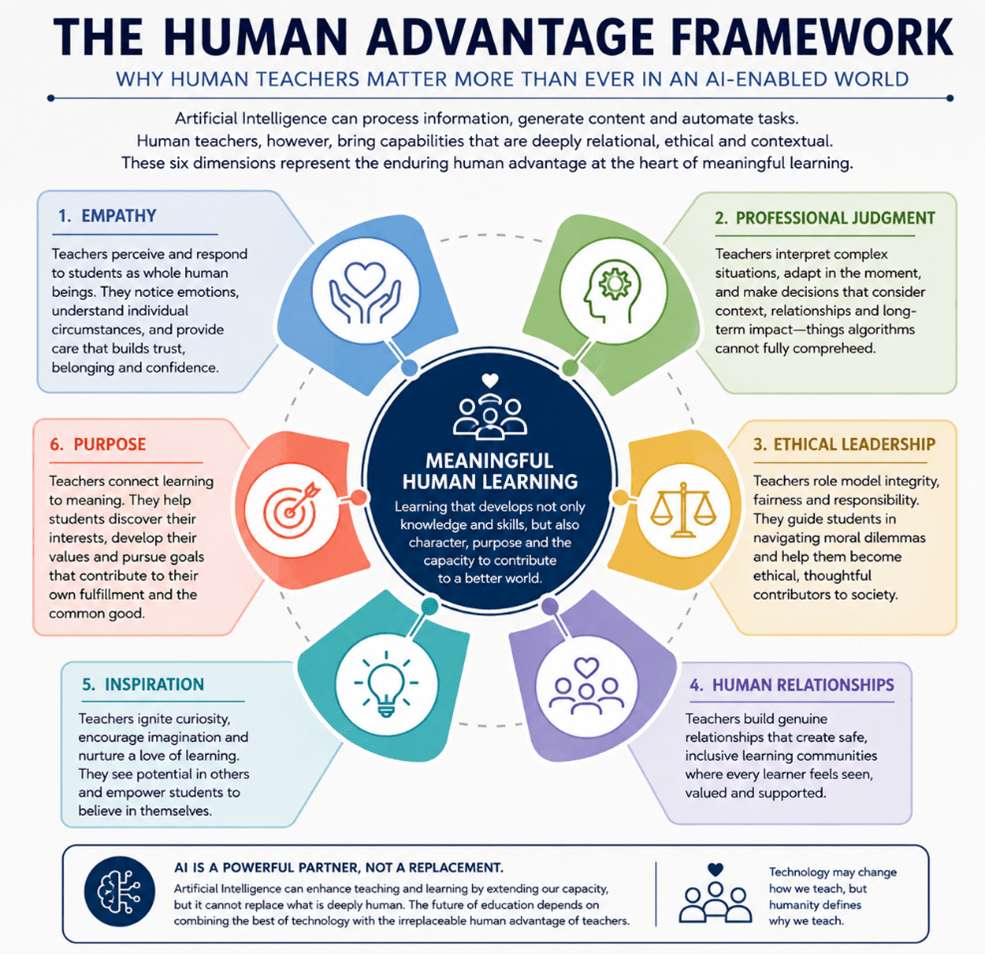
Figure 1. The Human Advantage Framework: A conceptual model positioning Meaningful Human Learning at the centre of six uniquely human dimensions of teaching in an AI-enabled world.
Source: Developed by the author.
The Human Advantage Framework does not suggest that artificial intelligence should be viewed as a threat to education. On the contrary, AI offers extraordinary opportunities to enhance teaching by automating routine administrative tasks, supporting personalised learning, expanding access to information, and providing timely instructional assistance. However, these technological capabilities become most valuable when they allow teachers to devote more time to the uniquely human dimensions of their profession.
Rather than replacing educators, artificial intelligence has the potential to redefine educational priorities. As machines increasingly perform informational tasks, teachers become even more important as mentors, ethical leaders, relationship builders, and designers of meaningful learning experiences. The future of education will therefore not be determined by the intelligence of our technologies alone, but by how intentionally schools cultivate the distinctly human qualities that no technology can fully replicate.
Implications for Educational Leaders: Building Human-Centred Schools in an AI-Enabled Future
The emergence of artificial intelligence requires educational leaders to rethink not only how technology is introduced into schools, but also how the teaching profession itself is supported and developed. If the uniquely human dimensions of teaching become increasingly valuable in an AI-enabled world, then school improvement efforts must move beyond technology adoption and focus equally on strengthening the professional capacities that machines cannot replicate.
The first implication is that artificial intelligence should be viewed as an instructional partner rather than a professional substitute. Educational leaders should encourage teachers to use AI to streamline administrative tasks, generate instructional resources, analyse assessment data, and personalise aspects of learning where appropriate. Every hour that technology saves through automation can become an hour reinvested in mentoring students, facilitating discussion, providing meaningful feedback, and strengthening classroom relationships. The objective is not to make teachers less important, but to allow them to devote more time to the work that is uniquely human.
Second, schools must redefine professional learning for the age of artificial intelligence. Traditional technology training often concentrates on learning how to operate digital tools. While technical competence remains essential, future professional development should place equal emphasis on ethical decision-making, critical evaluation of AI-generated content, responsible digital citizenship, instructional design, and pedagogical judgement. Teachers must become confident not only in using artificial intelligence but also in understanding its limitations, recognising bias, protecting student privacy, and modelling responsible technological practices.
A third implication concerns curriculum and assessment. As artificial intelligence becomes increasingly capable of generating factual responses and completing routine academic tasks, schools should place greater emphasis on learning experiences that require interpretation, creativity, collaboration, ethical reasoning, inquiry, and authentic problem-solving. Assessment practices should increasingly value students’ ability to justify decisions, communicate ideas, apply knowledge in unfamiliar contexts, and reflect upon their own learning processes. Such approaches reinforce the competencies that remain essential in an increasingly automated world.
Educational leaders must also preserve the relational foundations of schooling. Human connection should not become an unintended casualty of technological advancement. Classrooms should continue to be places where students experience belonging, encouragement, intellectual challenge, and meaningful dialogue. While artificial intelligence can personalise content, it cannot replace the trust that develops between teachers and learners over time or the sense of community that emerges through shared educational experiences. Protecting these relationships should remain a strategic priority for every school.
Finally, leadership itself must evolve. The role of educational leaders is no longer limited to selecting appropriate technologies or establishing implementation policies. Leaders must cultivate organisational cultures where innovation is balanced with ethical responsibility, where technological efficiency serves educational purpose, and where teachers are empowered to exercise professional judgement rather than becoming passive operators of digital systems. Future-ready schools will therefore be distinguished not by the quantity of technology they possess, but by the wisdom with which they integrate it into teaching and learning.
Artificial intelligence will undoubtedly continue to reshape education in profound ways. Yet its greatest contribution may not be the automation of instructional tasks. Instead, it may encourage schools to rediscover what has always been the defining strength of exceptional teaching: the ability to understand learners as human beings, inspire intellectual curiosity, exercise thoughtful judgement, and cultivate relationships that transform information into meaningful learning. In this sense, the future of education will remain profoundly human, even as the tools that support it become increasingly intelligent.
Questions for Reflection
Artificial intelligence is reshaping education at an extraordinary pace, yet the most important questions remain deeply human. As schools continue integrating intelligent technologies into teaching and learning, educational leaders, teachers, and policymakers must reflect not only on what technology can achieve but also on what kind of educational experiences they wish to preserve and strengthen.
As you consider your own educational context, reflect on the following questions individually or as part of a professional learning community.
- Which aspects of teaching in your school could be enhanced through artificial intelligence, and which should remain intentionally human regardless of technological advancement?
- Does your current professional development programme prepare teachers to use artificial intelligence critically, ethically, and pedagogically, or does it focus primarily on learning new digital tools?
- In an AI-enabled classroom, how will you ensure that empathy, relationships, belonging, and student well-being remain central to teaching rather than becoming secondary to technological efficiency?
- How might your curriculum evolve if information becomes increasingly accessible while critical thinking, ethical reasoning, creativity, and human judgement become more valuable?
- Which dimensions of The Human Advantage Framework—Empathy, Professional Judgment, Ethical Leadership, Human Relationships, Inspiration, or Purpose—are already strengths within your school? Which require more intentional development?
- Five years from now, what qualities would you most hope your students remember about their teachers, and are your current leadership decisions helping to cultivate those qualities today?
Cafe Learning Reflection
Every technological revolution has challenged educators to reconsider the purpose of schooling. The arrival of artificial intelligence is no exception. Yet perhaps the most valuable contribution of AI is not that it compels us to redesign our technologies, but that it compels us to rediscover what has always made teaching profoundly human.
Information has become increasingly abundant. Answers are available within seconds. Explanations can be generated instantly. In such a world, the value of education can no longer be measured simply by how effectively schools transmit knowledge. Its true purpose lies in helping learners interpret that knowledge wisely, apply it ethically, question it critically, and use it to contribute meaningfully to the lives of others.
Artificial intelligence may become an increasingly sophisticated educational partner, but partnership should never be confused with purpose. Technologies can support learning, extend human capability, and enhance instructional practice. They cannot replace the empathy that notices a student’s silent struggle, the professional judgement that adapts teaching to an unexpected moment, the encouragement that restores confidence after failure, or the inspiration that helps young people imagine futures they had never considered possible.
Perhaps the future of education will not be defined by the intelligence of our machines, but by the wisdom with which we choose to remain deeply human while using them. The schools that thrive in the decades ahead will not necessarily be those with the most advanced technologies, but those that understand that innovation reaches its highest purpose when it strengthens, rather than replaces, the relationships at the heart of learning.
Ultimately, the greatest advantage teachers possess has never been the ability to provide answers. It has always been the ability to help students discover who they can become.
Selected References
Darling-Hammond, L. (2024). The Flat World and Education: How America’s Commitment to Equity Will Determine Our Future (2nd ed.). Teachers College Press.
Luckin, R. (2018). Machine Learning and Human Intelligence: The Future of Education for the 21st Century. UCL Institute of Education Press.
Miao, F., Holmes, W., Huang, R., & Zhang, H. (2021). AI and Education: Guidance for Policy-makers. UNESCO.
OECD. (2019). OECD Learning Compass 2030: A Series of Concept Notes. OECD Publishing.
Selwyn, N. (2019). Should Robots Replace Teachers? AI and the Future of Education. Polity Press.
Sharma, U., & Holmes, W. (2022). Ethics of Artificial Intelligence in Education: Practices, Challenges and Debates. Routledge.
UNESCO. (2021). Reimagining Our Futures Together: A New Social Contract for Education. UNESCO Publishing.
UNESCO. (2023). Guidance for Generative AI in Education and Research. UNESCO Publishing.
World Economic Forum. (2023). The Future of Jobs Report 2023. World Economic Forum.
Zawacki-Richter, O., Marín, V. I., Bond, M., & Gouverneur, F. (2019). Systematic Review of Research on Artificial Intelligence Applications in Higher Education. International Journal of Educational Technology in Higher Education, 16(39).