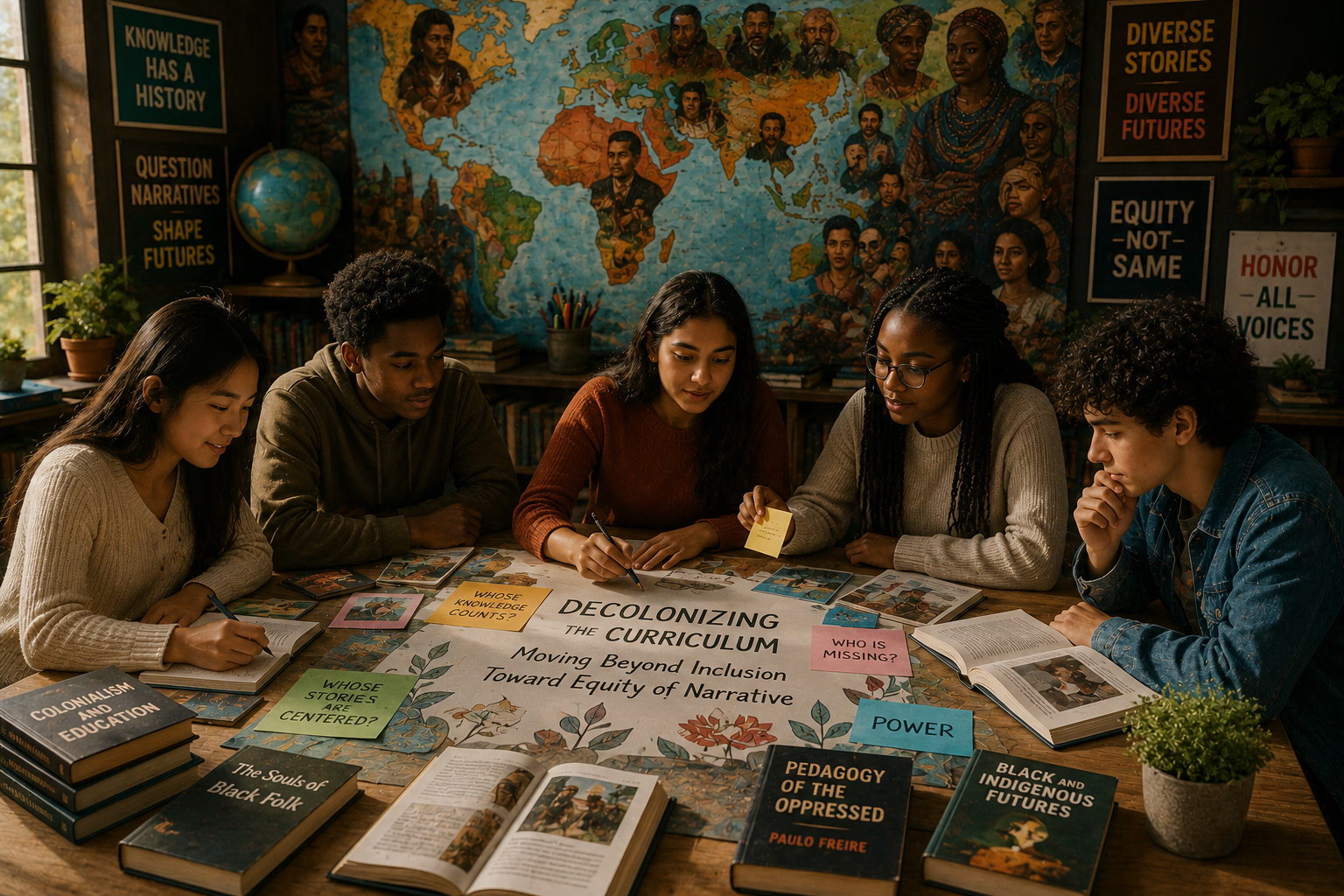
Decolonizing the Curriculum: Moving Beyond Inclusion Toward Equity of Narrative
For decades, education systems around the world have spoken the language of inclusion. Yet inclusion, when unexamined, often becomes performative—symbolic gestures layered onto curricula that remain fundamentally unchanged. The deeper challenge before us today is not representation alone, but equity of narrative: who defines knowledge, whose histories are legitimized, and whose ways of knowing are systematically marginalized.
Decolonizing the curriculum is no longer a radical proposition. It is an intellectual, ethical, and pedagogical necessity in an interconnected world grappling with inequality, migration, cultural erasure, and identity politics. At its core, this work asks a simple but unsettling question: Is our curriculum designed to transmit knowledge—or to preserve power?
Understanding Decolonization in Education
Decolonizing education does not mean rejecting Western knowledge or dismantling academic rigor. Rather, it involves interrogating the dominance of colonial epistemologies—systems of knowledge that have historically positioned Western thought as universal, neutral, and superior.
Postcolonial theorist Ngũgĩ wa Thiong’o famously argued that colonial education colonized not only land and labor, but the mind—through language, curriculum, and cultural hierarchy. When learners are taught to access success only by distancing themselves from their linguistic and cultural identities, education becomes a tool of assimilation rather than empowerment.
In practical terms, decolonizing the curriculum requires educators and leaders to question:
- Why certain histories are framed as central while others are peripheral
- Why “standard academic language” mirrors Western norms
- Why indigenous, local, and community-based knowledge is rarely positioned as intellectual capital
Curriculum, in this sense, is never neutral. It reflects values, power structures, and historical choices.
From Token Inclusion to Culturally Sustaining Education
Many schools attempt to address inequity by adding diverse texts or celebrating cultural events. While well intentioned, these approaches often fall short because they leave the underlying structure of the curriculum intact.
Culturally Sustaining Pedagogies, articulated by Django Paris and H. Samy Alim, push beyond responsiveness toward sustainability. The goal is not to help students adapt to dominant norms, but to sustain and extend their cultural, linguistic, and identity practices within academic spaces.
This shift reframes students not as recipients of knowledge, but as contributors to it. Their languages, narratives, and lived experiences become assets rather than obstacles.
Research consistently shows that when students see their identities reflected in learning:
- Engagement increases
- Critical thinking deepens
- Academic outcomes improve
- Sense of belonging strengthens
Decolonization, therefore, is not only a justice issue—it is a learning effectiveness strategy.
Language, Literacy, and Power
Language plays a central role in curricular equity. English-only policies, rigid academic registers, and deficit views of multilingual learners often reinforce colonial hierarchies in education.
Contemporary literacy research supports translanguaging—the strategic use of multiple languages—as a powerful cognitive and identity-affirming practice. When students are allowed to think, draft, discuss, and reflect using their full linguistic repertoire, learning becomes deeper and more authentic.
Children’s and young adult literature also serve as powerful tools in this process. Diverse literature expands students’ sense of belonging and voice, allowing them to see themselves not only as readers, but as legitimate subjects of knowledge. Attempts to censor such texts often reveal how deeply contested narrative power remains in education.
Critical Race Theory and Curriculum Analysis
Critical Race Theory (CRT) in education provides a lens for examining how race, power, and systemic inequities are embedded in curricular decisions. CRT does not accuse individual educators; it interrogates systems.
Through this lens, curriculum becomes a site where:
- Certain knowledge is normalized
- Other knowledge is problematized or erased
- Achievement gaps are produced rather than merely observed
Decolonizing the curriculum requires leaders to move from comfort to critical consciousness, asking difficult questions about neutrality, bias, and historical omission.
What Decolonized Curriculum Looks Like in Practice
A decolonized curriculum is not a fixed product—it is an ongoing process. In practice, it includes:
- Multiple perspectives in history, literature, and social sciences
- Alternative assessments such as portfolios, inquiry projects, and narrative evaluations
- Community-based learning, where local knowledge holders are recognized as educators
- Reflective pedagogy, encouraging students to question dominant narratives
- Equitable assessment design that values diverse ways of demonstrating understanding
These approaches align with global frameworks emphasizing learner agency, voice, and relevance.